 Beequation

Learn › Maths topics for Classes 1 to 5 › Addition and subtraction
Join, take away and compare
Addition and subtraction
Addition and subtraction describe more than joining and taking away. We add to find a total or an unknown part. We subtract to find what remains, what is missing or the difference between two quantities. Helping children recognise the situation is as important as helping them calculate.
Use counters, a number line and a place-value chart alongside written work. Ask your child or your students to explain what the answer represents: pencils, rupees, metres or something else.
How learning develops
- Class 1: join and take away small collections, tell number stories and use the signs +, and =; adding and subtracting within 9, then within 20.
- Class 2: count on, use pairs that make 10, and add and subtract two-digit numbers with carrying and borrowing.
- Class 3: three-digit (and in many books four-digit) sums, including borrowing across a zero.
- Class 4: four- and five-digit numbers, estimation and two-step word problems with money and measurement.
- Class 5: choose methods, estimate results and check multi-step word problems within the textbook's number range.
The national NIPUN Bharat targets are adding and subtracting numbers up to 9 in Class 1, up to 99 in Class 2 and up to 999 in Class 3. The exact order depends on the school book. Keep the same objects and pictures while the numbers grow.
Start with the meaning
Joining and taking away
There are 8 pencils in a pot and 5 beside it. Put them together to show 8 + 5 = 13. Then start with 13 pencils and remove 5 to show 13 5 = 8. The same objects explain how the operations are connected.
Ask the child to invent a matching story. It need not copy the wording of the homework question. The important thing is that the quantities and action agree with the calculation.
Finding the difference
One child has 13 counters and another has 8. Match the counters in pairs. Five are left unmatched, so the difference is 5. This gives 13 8 = 5 without taking anything away from either collection.
On a number line, count from 8 up to 13. This is useful when the two numbers are close. For example, the difference between 98 and 103 is 5: move 2 to reach 100, then 3 to reach 103.
Mental strategies children can explain
Make ten
For 8 + 5, split 5 into 2 and 3. Add 2 to make 10, then add the remaining 3:
8 + 5 = 8 + 2 + 3 = 13.
Use a ten-frame or two rows of five spaces to show why the split helps. Children need to know the pairs that make 10, such as 6 and 4 or 7 and 3. (Some books call these addition facts or number pairs.)
Partition and adjust
For 46 + 23, add 20 and then 3: 46 + 20 = 66, and 66 + 3 = 69. For 49 + 26, add 50 + 26 = 76, then subtract the extra 1 to get 75.
Ask which method suits the numbers. A child may count on for a small addition, adjust near a multiple of ten, or use columns when many place-value parts are involved.
Ask “What did you change, and how did you keep the value the same?” This question makes partitioning and adjustment visible.
Column addition with carrying
Many schools write sums one below the other, with H, T and O above the columns. Many parents learnt this as “carry over”; some Hindi-speaking teachers say हासिल. The newer NCERT books call it regrouping. These describe the same step. Work out 347 + 285. Line up ones under ones, tens under tens and hundreds under hundreds.
- Ones: 7 + 5 = 12 ones. Write 2 in the ones and carry 1 ten, written small at the top of the tens column.
- Tens: 4 tens + 8 tens + the carried ten = 13 tens. Write 3 in the tens and carry 1 hundred.
- Hundreds: 3 hundreds + 2 hundreds + the carried hundred = 6 hundreds.
The answer is 632. An estimate, 350 + 280 = 630, suggests that 632 is sensible. The small carried digits above a column stand for a ten or a hundred, not numbers that appear without a reason.
Column subtraction with borrowing
Many teachers call this “borrowing”; some Hindi-speaking teachers say उधार. Your child's book may say regrouping or exchanging. Borrowing doesn't change the total: it only changes how the number is split. For 532 178, begin with 5 hundreds, 3 tens and 2 ones.
- 2 minus 8: we can't, so borrow 1 ten and change it into 10 ones. There are now 5 hundreds, 2 tens and 12 ones. 12 8 = 4.
- 2 tens minus 7 tens: we can't, so borrow 1 hundred and change it into 10 tens. There are now 4 hundreds and 12 tens. 12 7 = 5 tens.
- Subtract 1 hundred from 4 hundreds to leave 3 hundreds.
The answer is 354. Check by adding: 354 + 178 = 532.
When there is a zero
For 500 278, borrow 1 hundred and change it into 10 tens, then borrow 1 of those tens and change it into 10 ones. The starting quantity is now represented as 4 hundreds, 9 tens and 10 ones. Subtract 2 hundreds, 7 tens and 8 ones to leave 222.
Children cross out the digit they borrow from and write the new digit above it. Before that, use a chart or a drawing to show the borrowing: a zero “becoming 9” makes sense once your child sees that 10 tens became 9 tens and 10 ones.
Common mistakes and useful responses
- Subtracting the smaller digit from the larger in every column: 532 178 is not 446. Build 532 and borrow where needed.
- Misaligned digits: use squared paper or label the columns before writing.
- Forgetting a carried digit: say its value aloud (“one ten”) and point to its column.
- Choosing an operation from one word in a word problem: draw the situation. “More” can appear in a question that needs subtraction.
Five-minute games for home
- Hidden counters: show 10 tamarind seeds or buttons, hide some under a katori and work out the hidden part.
- Number-line jumps: show 27 + 15 using a jump of 10 and then 5.
- Compare collections: pair two groups and describe the difference.
- Spot the method: compare two correct solutions to 49 + 26.
- Check my answer: give a subtraction answer and ask students to test it with addition.
Indie's challengeIndie has 500 counters and uses 278. How many remain? Explain the borrowing and check your answer. Show the answer
222 remain. Borrow to show 500 as 4 hundreds, 9 tens and 10 ones, then subtract 2 hundreds, 7 tens and 8 ones. Check: 222 + 278 = 500.
Free addition and subtraction worksheets
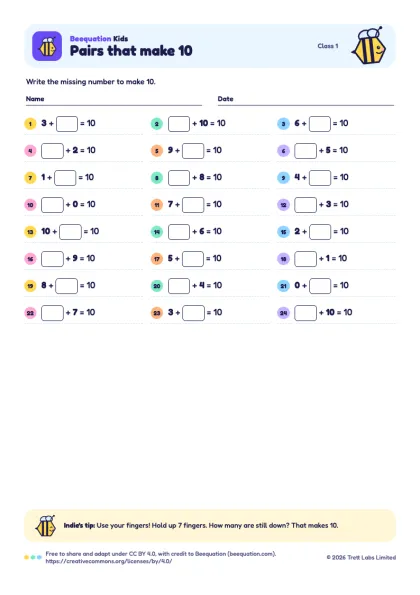 Pairs that make 10Class 1 · Number pairs that add up to 10Download PDF
Braille (BRF) (1 KB) · Braille text (3 KB)
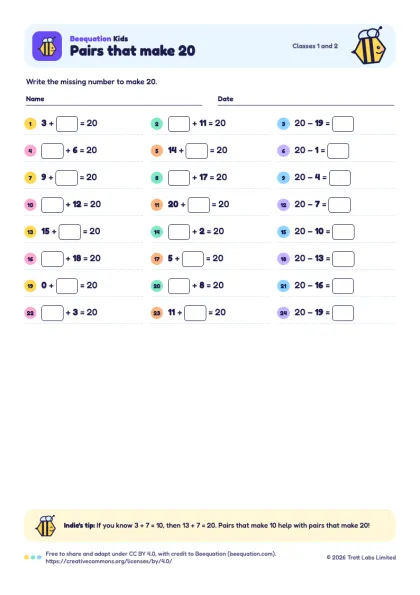 Pairs that make 20Class 1, Class 2 · Number pairs that add up to 20Download PDF
Braille (BRF) (1 KB) · Braille text (3 KB)
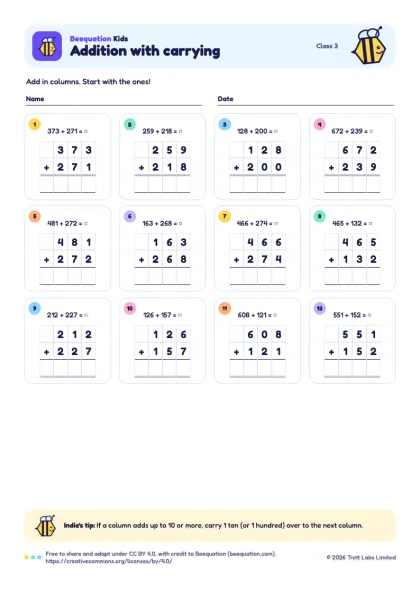 Addition with carryingClass 3 · Three-digit numbers in columns, with carryingDownload PDF
Braille (BRF) (1 KB) · Braille text (3 KB)
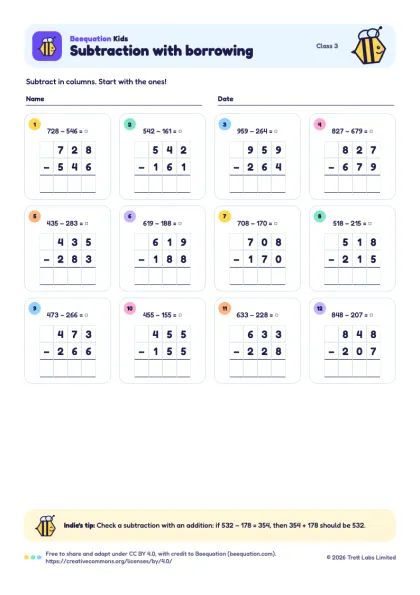 Subtraction with borrowingClass 3 · Three-digit numbers in columns, with borrowingDownload PDF
Braille (BRF) (1 KB) · Braille text (3 KB)
Questions parents and teachers ask
Use the school's recording method when helping with that work. You can still use objects or drawings to explain it. If the notation is unfamiliar, ask what each mark represents before replacing it with a different method.
No. Counting on, making ten or adjusting may be more efficient for particular numbers. Children benefit from explaining why they chose a method.
It is the newer word for carrying and borrowing: showing the same amount with different-sized units, such as ten ones as one ten, or one hundred as ten tens. Nothing is added to or taken from the total.
Practise with Indie
Beequation Kids turns number facts into honeycomb puzzles, with Indie giving a hint when a child is stuck. No ads and no data collected.