 Beequation

Learn › Maths help by class › Class 5 maths
A strong foundation for Class 6
Class 5 maths
By Class 5, children need to do more than remember a method. They need to decide when it is useful, explain the steps and check whether the result fits the situation. Most are about 10 to 11. There is still room for counters, folded paper and diagrams alongside written sums.
The NCERT book for Class 5 is Maths Mela. It works with five-digit numbers (ten thousands), factors and prime numbers, fractions, measurement, the 24-hour clock and bar graphs. Many private-publisher books cover more in Class 5, such as lakhs and crores, HCF and LCM, decimals and percentages. Treat your child's book and the teacher's instructions as the guide to what will be in the exams.
Read numbers by their places
In 47,306, there are four ten thousands, seven thousands, three hundreds, no tens and six ones. Write 47,306 = 40,000 + 7,000 + 300 + 6. Compare larger numbers from the highest place downwards rather than looking only at their last digits. More in counting and place value.
If your child's book goes beyond five digits, it will use the Indian system of lakhs and crores: 1,00,000 is one lakh and 1,00,00,000 is one crore. For example, 3,45,672 is read “three lakh forty-five thousand six hundred seventy-two”. Many private books also teach the international system alongside it (10 lakh = 1 million). The NCERT Class 5 book stops at five-digit numbers, so lakhs and crores depend on your child's book.
Estimate to check calculations. Four items costing about ₹2,400 each should cost about ₹9,600 altogether. The exact total may differ a little, but it should be close to that.
Choose and check written methods
Continue addition, subtraction and multiplication with the places lined up. In a word problem, find what is being asked before choosing an operation. A total cost, a difference, a number of groups and an equal share are different questions.
Worked example: 9,876 12
Take away useful multiples of twelve. Twelve groups of 800 make 9,600, leaving 276. Twelve groups of 20 make 240, leaving 36. Twelve groups of 3 make the remaining 36. Add 800 + 20 + 3 = 823. So 9,876 12 = 823, with no remainder.
Check by multiplying: 823 12 = 8,230 + 1,646 = 9,876. This partial-quotient method is how the NCERT books build up long division. Your child's school may use a shorter layout; use that layout for schoolwork while keeping the explanation. See multiplication and division.
When there is a remainder, check that dividend = divisor quotient + remainder, and that the remainder is smaller than the divisor. Decide what the leftover means in the story. If 50 children travel in vans that carry 8 each, 50 8 gives quotient 6 and remainder 2, so a seventh van is needed for the last two children.
Factors, multiples and prime numbers
A factor divides a number exactly. The factors of 12 are 1, 2, 3, 4, 6 and 12. Find them by making rectangles with twelve counters: 1 12, 2 6 and 3 4. Look for factor pairs so none are missed.
The factors of 18 are 1, 2, 3, 6, 9 and 18. The common factors of 12 and 18 are 1, 2, 3 and 6. Multiples are different: 12, 24, 36 and 48 are multiples of 12.
A prime number has exactly two factors, 1 and itself. 7 is prime. 8 is composite, because it has factors other than 1 and 8. 1 is neither prime nor composite. HCF and LCM appear in many private books in Class 5; in the NCERT books they come later.
Ask your child to give an example and explain why it fits. “7 is prime because…” tells you more than a memorised list of prime numbers.
Use fraction words accurately
In , the denominator, 4, tells us that the whole has four equal parts. The numerator, 3, tells us how many of those parts we mean. Keep the same-sized whole when comparing pictures. (In Hindi, numerator is अंश and denominator is हर, and is read “तीन बटे चार”.)
Equivalent fractions name the same amount. Multiplying both numerator and denominator by 2 gives = . To simplify , divide both by their common factor 2 to get . A picture of eighths paired together shows the same change. More in fractions.
Worked example: +
Use pieces of the same size. One-half is two-fourths, so + = + = . Check by shading a half and one more quarter on a single strip. Adding the denominators would change the size of the pieces, so + is not .
To compare, = and = , so is larger. For a fraction of a quantity, find one part first: three-fourths of 20 is three groups of 5, or 15. Multiplying a fraction by a whole number can be seen as repeated addition: 3 = .
Adding and subtracting fractions with different denominators, like the example above, is common in Class 5 books. If your child's book doesn't include it yet, there is no hurry.
Area, perimeter and volume
A rectangle 9 m long and 4 m wide has area 9 4 = 36 m². Its perimeter is 9 + 4 + 9 + 4 = 26 m. Area measures a surface; perimeter measures a boundary. Writing the correct unit keeps the difference clear. See measurement.
For a square of side 6 cm, the area is 6 6 = 36 cm² and the perimeter is 4 6 = 24 cm. Draw both on squared paper and trace the edge before counting the squares inside.
Volume describes the space something takes up. Build a cuboid with unit cubes: three cubes along, two across and two layers high gives 3 2 2 = 12 unit cubes. Begin with this model rather than learning a formula without knowing what is being counted.
Time, geometry and bar graphs
Read railway and bus timetables in the 24-hour clock and find journey times by counting along a timeline. A journey from 09:45 to 11:20 takes 1 hour 35 minutes: fifteen minutes to 10:00, one hour to 11:00 and twenty minutes more.
Describe right, acute and obtuse angles, investigate circles and nets, and follow maps with attention to direction. The NCERT books name these angles without measuring them; many private books also measure angles in degrees with a protractor in Class 5.
On a bar graph, read the title, the labels and the scale first. If each step on the scale stands for two children, a bar reaching the fourth step stands for eight children, not four. Compare totals and differences, and ask whether the graph has enough information to answer a question. See data handling.
Number patterns, square numbers, triangular numbers and magic squares encourage reasoning. Explain a pattern's rule and check it on more than one step.
Exams and entrance tests in Class 5
Many schools set their own unit tests, half-yearly and annual exams. In some states and schools, children who don't pass the Class 5 annual exam get a second chance through a re-exam.
Some families consider entrance exams such as the JNVST for Jawahar Navodaya Vidyalayas or the AISSEE for Sainik Schools. If you are considering one, check the organiser's current notice for eligibility, subjects, format and any fees. Ask your school whether participation is optional, and keep everyday maths focused on understanding.
By the end of Class 5, many children can…
- read, write and compare five-digit numbers, and lakhs and crores if their book teaches them;
- multiply and divide larger numbers and check with the inverse operation;
- find factors and multiples, and say whether a small number is prime;
- find equivalent fractions and compare fractions;
- work out the perimeter and area of rectangles and squares;
- read 24-hour times and bar graphs.
Children reach these at different times. What matters for Class 6 is understanding, not speed.
Words your child will hear
Ten thousands, lakh, crore; factor, multiple, common factor, prime, composite; numerator, denominator, equivalent fractions, simplest form; area, perimeter, volume, square metre; acute, obtuse, right angle; bar graph, scale. In Hindi: गुणनखंड (factor), गुणज (multiple), अंश (numerator), हर (denominator).
Indie's challengeIndie orders 4 wooden beehive boxes costing ₹2,350 each. What is the total cost? Show the answer
4 ₹2,350 = ₹9,400. Four lots of ₹2,000 give ₹8,000 and four lots of ₹350 give ₹1,400. Together that is ₹9,400. Check: ₹9,400 4 = ₹2,350.
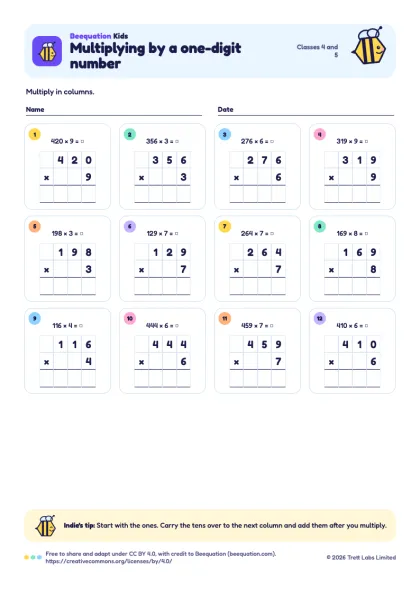 Multiplying by a one-digit numberClass 4, Class 5 · Three-digit numbers one-digit numbers, in columnsDownload PDF
Braille (BRF) (1 KB) · Braille text (3 KB)
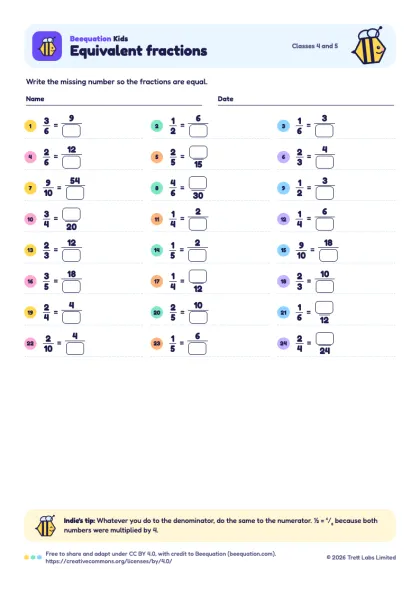 Equivalent fractionsClass 4, Class 5 · Find the missing numberDownload PDF
Braille (BRF) (2 KB) · Braille text (3 KB)
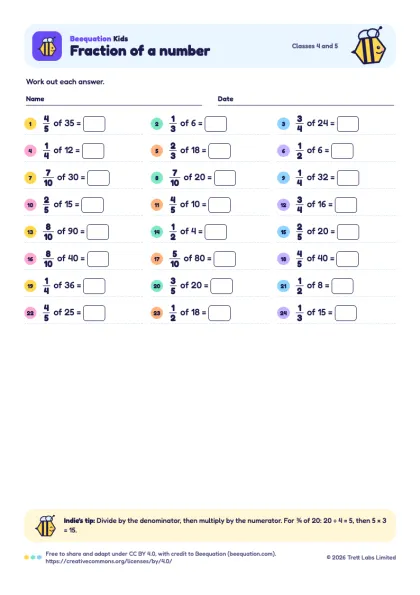 Fraction of a numberClass 4, Class 5 · Like of 12 and of 20Download PDF
Braille (BRF) (1 KB) · Braille text (3 KB)
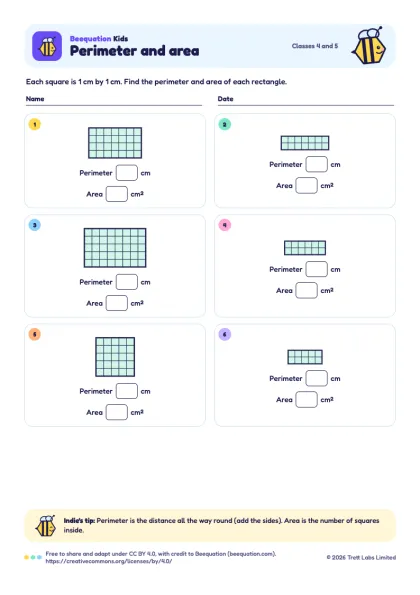 Perimeter and areaClass 4, Class 5 · Rectangles on a centimetre gridDownload PDF
Braille (BRF) (2 KB) · Braille text (4 KB) · Tactile pictures (PDF) (59 KB)
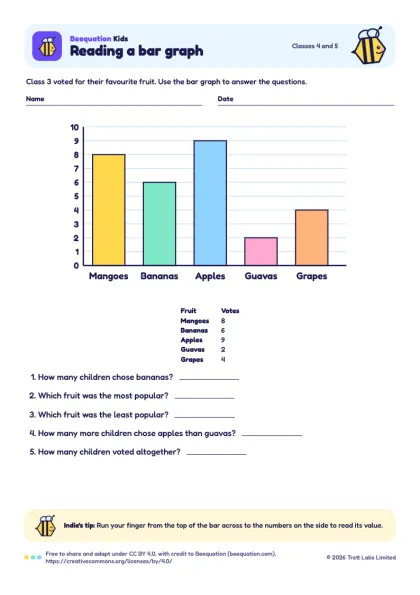 Reading a bar graphClass 4, Class 5 · Favourite fruit surveyDownload PDF
Braille (BRF) (1 KB) · Braille text (2 KB) · Tactile pictures (PDF) (41 KB)
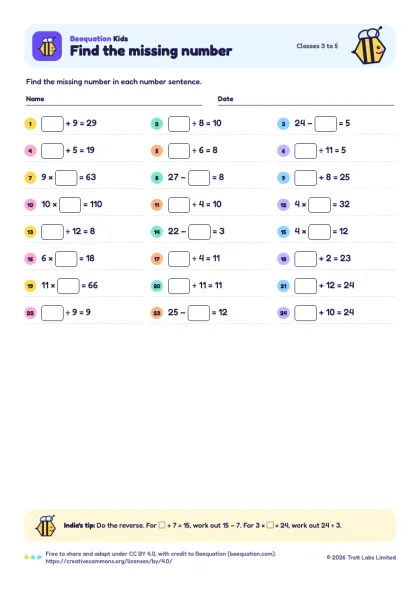 Find the missing numberClass 3, Class 4, Class 5 · Find the number in the boxDownload PDF
Braille (BRF) (1 KB) · Braille text (3 KB)
Quick answers
Not in the NCERT Class 5 book. Many private books start decimals in Class 4 or 5 and percentages in Class 5 or 6. Check your child's book; our decimals and percentages page helps if they do.
Ask the teacher or look at the next year's book to see which topics come next. There is no need to rush ahead of your child's current work.
Practise with Indie
Beequation Kids turns number facts into honeycomb puzzles, with Indie giving a hint when a child is stuck. No ads and no data collected.
Previous: Class 4 maths · All class guides · Read maths tests explained.