 Beequation

Learn › Maths topics for Classes 1 to 5 › Multiplication and division
Maths topics · Classes 1 to 5
Multiplication and division
Multiplication finds a total when groups are equal. Division can share a total into equal groups or find how many groups of a given size can be made. Children need to see these meanings before they memorise a written method.
Use counters, seeds, bottle caps or drawn circles. Ask your child to describe what each number represents: the number of groups, the size of each group or the total. A correct calculation is more useful when the child can connect it to the question.
Multiplication and division across the classes
- Class 1: make small equal groups in play and share objects fairly, without symbols.
- Class 2: multiplication as repeated addition and equal groups, the sign, and the first tables (2, 3, 4, 5 and 10 in most books); division as fair sharing.
- Class 3: tables up to 10, multiplying by a one-digit number, the sign, division facts and remainders.
- Class 4: multiplying by a two-digit number, long division by a one-digit number, and multiples (factors too in many books).
- Class 5: larger numbers, long division by two-digit numbers, factors and prime numbers; HCF and LCM in many private books.
The national NIPUN Bharat targets include the tables of 2, 3 and 4 in Class 2 and the tables of 2 to 10, with division facts, by the end of Class 3. Many schools and families then go on to tables up to 20 in Classes 4 and 5. That is common practice, but understanding what the facts mean comes first.
Equal groups and arrays
Three plates with seven laddoos on each plate contain 7 + 7 + 7 = 21 laddoos. Write this as 3 7 = 21: three groups of seven.
An array arranges objects in equal rows and columns. Draw three rows of seven dots. Turn the paper and you can see seven rows of three dots. The total remains 21, showing that 3 7 = 7 3.
This change of order works for multiplication. It does not work in the same way for division: 21 3 = 7, but 3 21 is not 7. Keep the meaning of each operation visible.
Before your child multiplies, ask them to check that every group really has the same number. If one plate has fewer laddoos, a single multiplication no longer describes it; they need to add instead.
Build tables from facts your child knows
Many children learn tables by reciting them aloud: “two ones are two, two twos are four…” (in Hindi, the पहाड़ा: “दो एकम दो, दो दूनी चार”). Reciting helps memory, and tables become more meaningful when children can rebuild a forgotten fact. If your child knows 5 6 = 30, one more group of six gives 6 6 = 36. If 4 7 = 28, doubling the total gives 8 7 = 56.
Connect each new fact to an array or equal groups. Counting in twos, fives and tens is helpful, but children should also explain what they are counting. Five jumps of two reach 10 because there are five equal groups of two.
Practise a few facts at a time, mixing questions rather than reciting only in order. Allow time to think. A child who derives an answer accurately is using mathematics, even before recall becomes fluent.
Two meanings of division
Sharing: Put 24 laddoos into four boxes equally. Each box receives six, so 24 4 = 6. Here you know the number of boxes and find the amount in each.
Grouping: Put 24 laddoos into boxes holding six each. You need four boxes, so 24 6 = 4. Here you know the amount in each box and find the number of boxes.
Use the same objects for both questions. Ask which number changed its role. This helps children avoid treating every division question as “share between this many people”.
The related facts form a family: 4 6 = 24, 6 4 = 24, 24 4 = 6 and 24 6 = 4. Multiplication and division undo one another when used this way.
Multiply using place value
To calculate 234 23, split 23 into 20 and 3. This example suits children whose textbook includes multiplication by a two-digit number.
234 3 = 702
234 20 = 4,680
702 + 4,680 = 5,382
The second partial product is 4,680, not 468, because it is twenty groups of 234. In the column method, many teachers ask children to write a 0 (some use a cross) in the ones place of the second row before multiplying by the 2. Ask your child to say why: “this row is multiplying by twenty, not two.”
Estimate: 234 is near 230 and 23 is near 20, giving about 4,600. An exact answer of 5,382 is reasonable. An answer of 538 would be far too small: even 234 3 is already 702.
Divide in manageable parts
Consider 857 4. Find useful multiples of four, then keep track of the groups removed:
4 200 = 800; 857 800 = 57.
4 10 = 40; 57 40 = 17.
4 4 = 16; 17 16 = 1.
The quotient is 200 + 10 + 4 = 214, with remainder 1. The NCERT books for Classes 4 and 5 call these steps partial quotients and write them in the familiar bracket layout, with the divisor on the left and the quotient on the right: 4 ) 857 ( 200 + 10 + 4.
The traditional long division layout that most parents know is the same idea in a shorter form. Say the steps as “divide, multiply, subtract, bring down”:
Some books write the quotient above the dividend instead; the steps are the same. Keep to the layout in your child's copy, and make sure they can explain the value of every step.
Check: 4 214 + 1 = 856 + 1 = 857. The remainder is smaller than the divisor, 4. If four or more objects remained, another complete group could still be made.
For a division with no remainder, 9,876 12 = 823. Check by multiplying: 823 12 = 8,230 + 1,646 = 9,876. Use this larger example only when it matches the book's level.
What does the remainder mean?
Twenty-six pencils packed three to a box give 26 3: quotient 8, remainder 2. Eight boxes are full, with two pencils left over.
If the question asks for the number of full boxes, the answer is eight. If all pencils must be packed, you need nine boxes, with the last box partly filled. The calculation is the same, but the question changes the final answer.
Do not discard a remainder automatically or round up every time. Ask what is being counted and what must happen to the leftover amount.
Useful words
The product is the answer to a multiplication; in 234 23, 234 is the multiplicand and 23 the multiplier. In 24 4 = 6, 24 is the dividend, 4 the divisor and 6 the quotient. A remainder is what is left after making complete equal groups. Indian books always teach the check dividend = divisor quotient + remainder. In Hindi these are भाज्य, भाजक, भागफल and शेषफल. Introduce the words alongside a worked example, not as a list to learn without meaning.
Common mistakes and practice ideas
- Unequal groups: build an example with one different group and discuss why a single multiplication does not describe it.
- Lost place value: label the partial products “three groups” and “twenty groups” before adding.
- Tables without meaning: draw the matching array for a fact your child recalls.
- Ignoring leftovers: use counters to compare full boxes with boxes needed for everything.
- No check: multiply the quotient by the divisor, add the remainder and compare with the dividend.
For short classroom practice, let pairs create an array, write its fact family and swap it with another pair. At home, share 12 counters in different ways and record the number and size of the groups.
Indie's challengeIndie has 26 seeds. Each packet holds three seeds. How many packets does she need to pack every seed? Show the answer
26 3 gives quotient 8 and remainder 2. Eight packets hold 24 seeds, leaving two. Indie needs one more packet for those, so she needs nine packets altogether.
Free multiplication and division worksheets
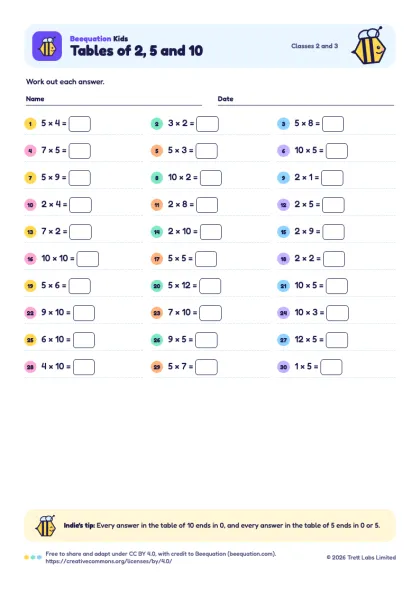 Tables of 2, 5 and 10Class 2, Class 3 · Mixed questions from the tablesDownload PDF
Braille (BRF) (2 KB) · Braille text (4 KB)
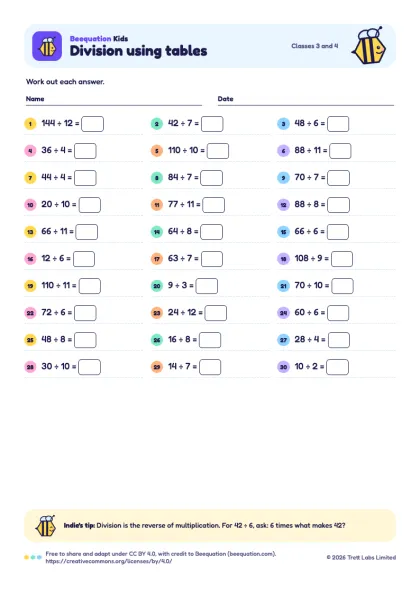 Division using tablesClass 3, Class 4 · Use the tables to divideDownload PDF
Braille (BRF) (2 KB) · Braille text (4 KB)
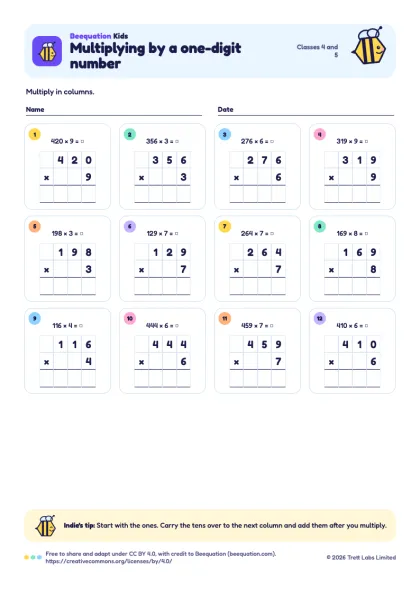 Multiplying by a one-digit numberClass 4, Class 5 · Three-digit numbers one-digit numbers, in columnsDownload PDF
Braille (BRF) (1 KB) · Braille text (3 KB)
Questions parents and teachers ask
Use both. Objects and arrays establish meaning; short, regular practice supports recall. Let children use a known fact to derive another.
First check the teacher's layout. Consistent notation helps your child follow lessons, while the explanation should always show the groups, place values and remainder.
No. It may be the correct result when a total cannot make complete equal groups. Interpret the leftover amount according to the question.
Practise with Indie
Beequation Kids turns number facts into honeycomb puzzles, with Indie giving a hint when a child is stuck. No ads and no data collected.