 Beequation

Learn › Maths help by class › Class 1 maths
Building number sense
Class 1 maths
Class 1 maths begins with things children can see and handle: buttons, pencils, leaves, bangles, toys and their own fingers. The aim is not to fill a copy with answers as quickly as possible. It is to understand what a number means and what changes when we add or take something away.
Class 1 is generally described as ages 6–7; check your state's current admission rules and cut-off date. Many arrive from Nursery, LKG and UKG, or from Balvatika in some schools, already able to count a little. Schools use different books and sequences, so follow your child's current lesson rather than treating this page as a weekly syllabus. The NCERT book for Classes 1 and 2 is Joyful Mathematics, which builds ideas through pictures, games and familiar situations.
The national NIPUN Bharat mission sets learning targets for each early class. For Class 1, they are counting objects up to 20, reading and writing numbers up to 99, and adding and subtracting numbers up to 9. Class 1 is part of the Foundational Stage, where the national curriculum framework (NCF-FS) says that formal tests and exams are not the right way to assess children; teachers learn most by watching children work and looking at what they make.
Count objects, not only number names
A child may recite numbers confidently and still lose track while counting objects. Put out six spoons. Ask your child to touch or move each spoon as they count. Then ask, “How many altogether?” The last number said tells us the total. This is the heart of counting and place value.
Begin with small collections, including numbers from 1 to 9, and introduce zero through an empty plate. Build towards counting to 20, and recognising larger numbers as the school introduces them. Children meet number sequences up to 50 and then 99 or 100, but understanding a small collection matters more than racing through a long sequence.
- Ask for the number that comes before, after or between two numbers.
- Match a written number to the correct collection.
- Compare two groups: which has more, fewer or the same number?
- Practise number names in words (“seven”) alongside numerals (7).
For example, put seven buttons in one group and five in another. Match them in pairs. Two buttons remain in the first group, so seven is more than five. Your child doesn't need the > sign to explain this; in the NCERT books it comes in Class 3.
Make a ten
Tens and ones are easier to understand when a ten is something children can hold. Bundle ten ice-cream sticks together with a rubber band. Put three loose sticks beside the bundle. You have one ten and three ones: 13. Teachers call this “bundles and sticks”.
Now compare 13 and 16. Both have one bundle of ten; the loose sticks tell us which is larger. Keep the bundles visible while your child explains. Later, they can draw a bundle and dots instead of handling the sticks.
Counting in 2s, 5s or 10s can grow out of real groups: pairs of chappals, fingers on hands or bundles of sticks. Use small groups first. Words such as first, second and third describe position rather than how many there are. Line up toys and ask which is first or fifth; extend towards tenth when your child is ready.
Change the arrangement without changing the objects. Ask whether six buttons spread out are still six. Let your child count to check rather than telling them straight away.
Add and take away
Start with adding and taking away small numbers, up to 9, then extend within 20 as understanding grows. Explain the signs as part of a story: + means adding, means taking away or finding a difference, and = means the two sides have the same value.
Worked example: 8 + 5
Put out eight laddoo cut-outs and another five. Move two from the group of five to complete a ten with the eight. Three remain. So 8 + 5 = 10 + 3 = 13. Your child can also count on five steps from eight: 9, 10, 11, 12, 13.
Worked example: 14 6
Make fourteen with a bundle of ten and four loose sticks. Remove the four loose sticks to reach ten, then open the bundle and remove two more. Eight remain, so 14 6 = 8. Check by putting six back: 8 + 6 = 14.
“Pairs that make 10” help children see different ways to make the same total. Ten can be 6 + 4, 7 + 3 or 5 + 5. Give your child ten objects and ask them to split the collection in different ways. Written two-digit sums in columns are not the starting point for these ideas.
Notice shapes and compare measurements
A ball and a box behave differently. Roll them, slide them and talk about what happens. Look for circles, triangles, squares and rectangles in pictures, rangoli and around the classroom. Ask your child to describe what they notice rather than relying only on a memorised name.
Compare longer and shorter pencils, heavier and lighter objects, or containers that hold more and less. Line up objects at one end before comparing length. Measure a table with handspans (a balisht, in Hindi) or a path with footsteps. If two people get different answers, compare the size of their hands or steps. Centimetres usually come later.
Daily routines also give meaning to time: morning assembly, tiffin, after school, yesterday and tomorrow. Talk about the days of the week and the order of events. Some books start o'clock times in Class 1 and others in Class 2; either way, this practical sense of time comes first.
Money, patterns and simple records
Let your child look at familiar coins and notes with you: ₹1, ₹2, ₹5 and ₹10 coins, and ₹10, ₹20 and ₹50 notes. The value matters, not the physical size. In a pretend shop, a pencil costing ₹5 can be paid for with five ₹1 coins or one ₹5 coin. Keep the task small enough that your child can count the whole amount.
Make repeating patterns with leaves and stones, or red and blue blocks. Ask what repeats and what comes next. A pattern such as leaf, stone, leaf, stone continues with a leaf after the next stone. Children can also record choices with one mark for each person: one mark for each child who chooses mango, for example.
By the end of Class 1, many children can…
- count a collection of up to 20 objects, touching each one once;
- read and write numbers to 99, and say the number that comes before or after;
- show a number such as 16 as one ten and six ones;
- add and subtract small numbers, up to 9 and then within 20, with objects or a number line;
- name circles, triangles, squares and rectangles, and compare lengths and weights directly;
- recognise the coins and notes they meet at home.
Children get there at different speeds. If your child isn't there yet, go back to objects and small numbers; that is normal at this age.
Words your child will hear
Before, after, between; more, fewer, same; tens and ones; bundle; add, take away, altogether, left; longer, shorter, heavier, lighter; first, second, third. In Hindi-medium classes: इकाई (ones), दहाई (tens), जोड़ (add), घटाना (take away).
Help without taking over
Choose one short activity and stop while your child still feels comfortable. Read a word problem aloud if the reading is getting in the way. Let them explain in the language they know best, then help connect the idea to the words used at school. Praise a careful check or a clear explanation, not only a correct answer.
Indie the honeybee counts flowers one at a time. She can make a mistake and count again; so can your child. If schoolwork often upsets your child, share a specific example with the class teacher at the next PTM rather than adding more practice of the same kind.
Indie's challengeIndie visits 7 flowers in the morning and 6 in the afternoon. How many flowers does she visit? Show the answer
7 + 6 = 13. Move three from the six to make ten with the seven. Ten and the remaining three make thirteen. Count all thirteen flowers to check.
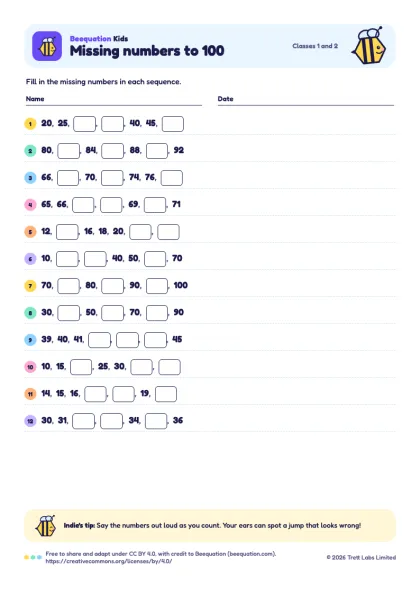 Missing numbers to 100Class 1, Class 2 · Count in 1s, 2s, 5s and 10sDownload PDF
Braille (BRF) (1 KB) · Braille text (3 KB)
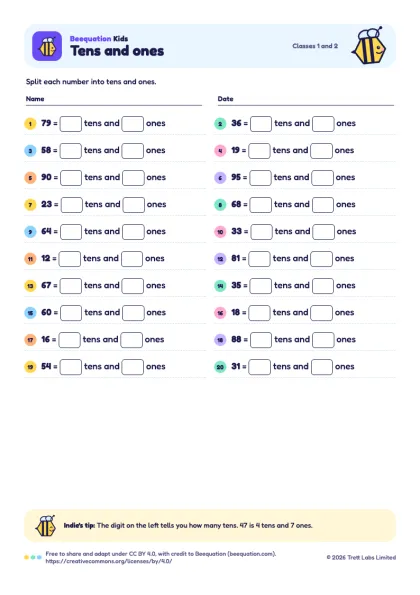 Tens and onesClass 1, Class 2 · Break two-digit numbers into tens and onesDownload PDF
Braille (BRF) (2 KB) · Braille text (4 KB)
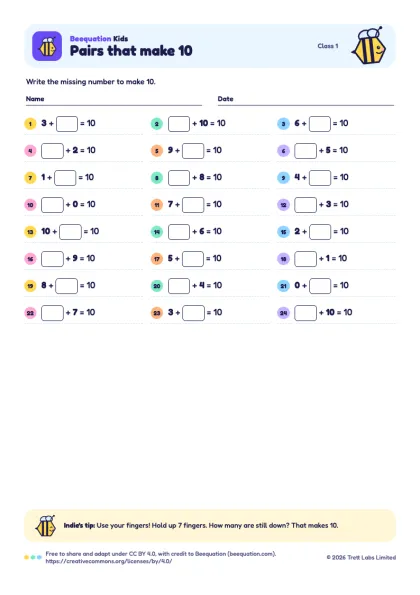 Pairs that make 10Class 1 · Number pairs that add up to 10Download PDF
Braille (BRF) (1 KB) · Braille text (3 KB)
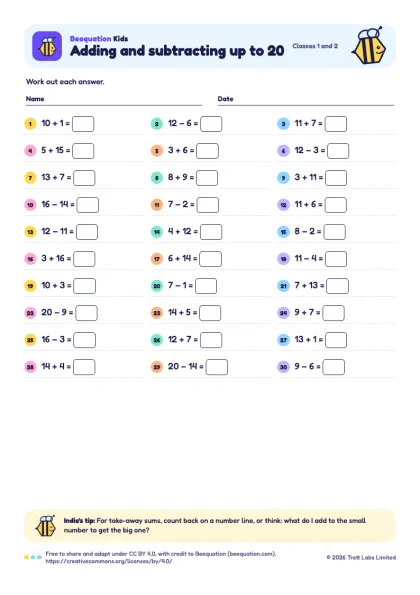 Adding and subtracting up to 20Class 1, Class 2 · Mixed sums up to 20Download PDF
Braille (BRF) (2 KB) · Braille text (4 KB)
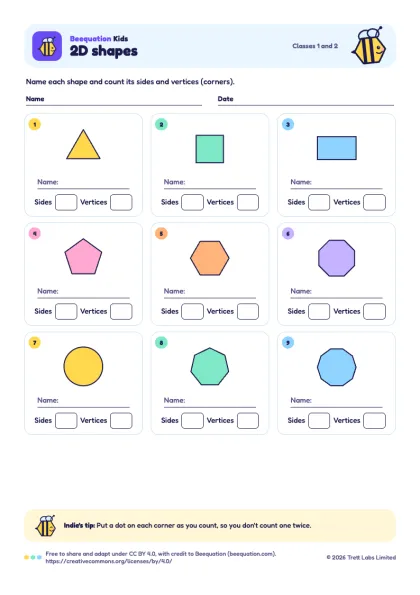 2D shapesClass 1, Class 2 · Names, sides and cornersDownload PDF
Braille (BRF) (2 KB) · Braille text (4 KB) · Tactile pictures (PDF) (77 KB)
Quick answers
Many books go up to 99 or 100 by the end of Class 1, and the NIPUN Bharat target is reading and writing numbers up to 99. Counting real objects accurately and understanding tens and ones matter more than writing a long list.
Many schools hold short tests or report grades, but the national framework for this stage (NCF-FS) prefers watching children and looking at their work over formal tests. Ask the class teacher how your child's school assesses Class 1.
Practise with Indie
Beequation Kids turns number facts into honeycomb puzzles, with Indie giving a hint when a child is stuck. No ads and no data collected.
All class guides · Next: Class 2 maths · More ideas in everyday maths.