 Beequation

Learn › Maths topics for Classes 1 to 5 › Fractions
Maths topics · Classes 1 to 5
Fractions
A fraction tells us about equal parts of a whole or equal shares of a collection. Children need time to handle, draw and compare these parts before working with symbols. Folding paper and sharing counters are often more useful than a page of rules.
Start with the work in your child's textbook. In the current NCERT books, halves and quarters appear in Class 3 through sharing and folding, and the words numerator and denominator come in Class 5. Many private-publisher books use those words earlier. There is no need to introduce all the vocabulary at once.
How fractions develop through primary school
- Class 1: share objects fairly and talk about “half” in everyday situations.
- Class 2: halves and quarters of shapes in some books, through sharing and folding.
- Class 3: one-half, one-fourth and three-fourths of a shape and of a collection; one-third in many books.
- Class 4: equivalent fractions and comparing fractions; like and unlike, proper, improper and mixed fractions in many private books.
- Class 5: numerator and denominator, equivalent fractions and comparing fractions; adding and subtracting unlike fractions in many books.
The national NIPUN Bharat target for the end of Class 3 is finding half, one-fourth and three-fourths of a whole and of a collection. Schools use different books, so follow the order in your child's book.
The parts must be equal
Fold a rectangular sheet into two matching parts. Each part is one-half, written . Fold it again to make four matching parts. Each part is one-fourth, written ; most people also call it a quarter.
Now shade three of those four parts. The shaded fraction is : three-fourths, or three quarters. In Hindi it is read “तीन बटे चार” or “तीन-चौथाई”. We count the equal parts, not how dark the shading is or how much space the picture takes on the page.
A roti cut into a large piece and a small piece has two pieces, but they are not halves. Ask, “How could we check whether these pieces are equal?” Children might match paper pieces or compare their areas.
Understand the two numbers
In , the denominator (हर in Hindi), 4, says that the whole has been divided into four equal parts. The numerator (अंश), 3, says how many of those parts we are considering.
Keep a picture beside the notation. Ask your child to point to the whole, then one part, then the three shaded parts. A child who can name the numbers but cannot identify the whole still needs practical work.
Keep the whole in view. Before your child compares two fractions, check together that the two shapes or collections they started from are the same size.
Compare fractions using the same whole
Take two identical paper strips. Divide one into three equal parts and the other into five. One-third is larger than one-fifth: > . Dividing the same whole into more equal pieces makes each piece smaller.
For fractions with the same denominator, count the parts. Three-fourths is greater than one-fourth because three equal parts are more than one of those parts: > .
Be careful with real food. Half a large mango may contain more fruit than half a small mango. Both are halves of their own mango, but the wholes are different. Use identical paper shapes when teaching a comparison.
Different fractions can name the same amount
Shade half a strip. Divide that same strip into four equal parts without changing the shading. Two of the four parts are shaded. Divide it into eight equal parts and four are shaded.
= = . These are equivalent fractions. The names change, but the shaded amount does not.
Once the picture is understood, connect it to the numbers: multiplying both numerator and denominator by 2 turns into . Multiplying both by 4 turns into . Changing only one number changes the fraction.
Find a fraction of a collection
To find of 20 counters, first split the counters into four equal groups. Each group contains 20 4 = 5 counters. Take three groups: 3 5 = 15.
of 20 = 15. The denominator tells us the number of equal groups; the numerator tells us how many groups to take.
For one-third of 12 laddoos, make three equal shares. Each share has four laddoos, so of 12 is 4. Use counters for the explanation rather than asking children to handle food unnecessarily.
Add and subtract parts
Where the textbook introduces fraction sums, begin with parts of the same size (books call these like fractions). One-fourth plus two-fourths is three-fourths: + = . The pieces are still fourths, so the denominator stays 4.
Three-fourths minus one-fourth leaves two-fourths: = = .
With unlike fractions (different denominators), which many books teach in Class 5, use equivalent fractions first. To work out + , divide a strip into six equal parts. One-half is and one-third is . Together they make .
In the same way, becomes = . Drawing the parts explains why a common denominator is useful; it is not a rule to memorise without meaning.
Common mistakes to discuss
- Counting unequal parts: check equality before naming a fraction.
- Thinking a larger denominator means a larger piece: compare thirds and fifths of identical strips.
- Adding denominators: + is , not . The size of each part has not changed.
- Losing track of the whole: name the whole explicitly before comparing pictures or collections.
Five-minute games for home
- Fold a paper roti into halves and quarters, then label the parts.
- Draw two different shapes that each show .
- Share 12 counters between two, three and four toy plates.
- Make a matching game with pictures and equivalent fraction cards.
- Ask students to draw a convincing example and a non-example of one half.
Indie's challengeThere are 24 counters. Indie takes one-fourth of them, then gives away half of her share. How many counters does she keep? Show the answer
One-fourth of 24 is 24 4 = 6. Half of 6 is 3, so Indie gives away 3 and keeps 3 counters.
Free fraction worksheets
Choose shaded parts before symbolic calculations if the idea of equal parts is still developing.
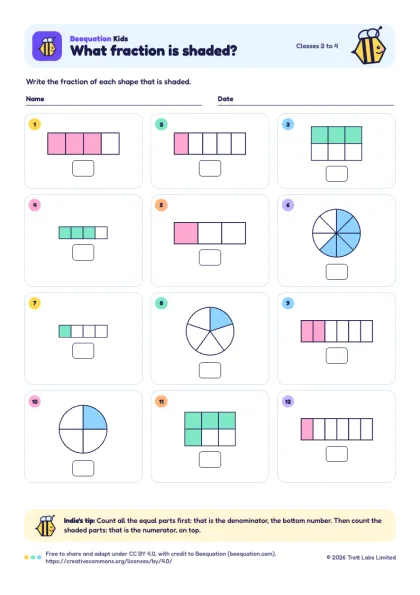 What fraction is shaded?Class 2, Class 3, Class 4 · Halves, thirds, quarters and moreDownload PDF
Braille (BRF) (1 KB) · Braille text (3 KB) · Tactile pictures (PDF) (675 KB)
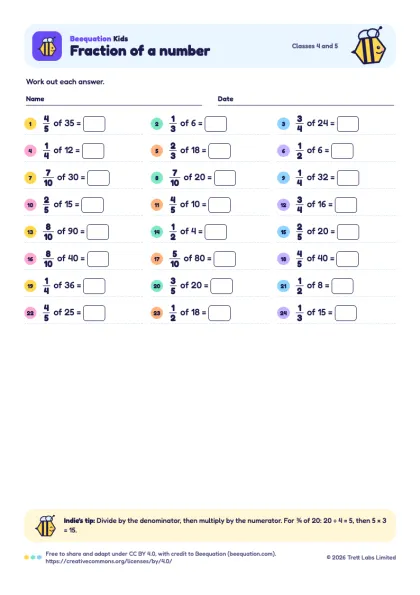 Fraction of a numberClass 4, Class 5 · Like of 12 and of 20Download PDF
Braille (BRF) (1 KB) · Braille text (3 KB)
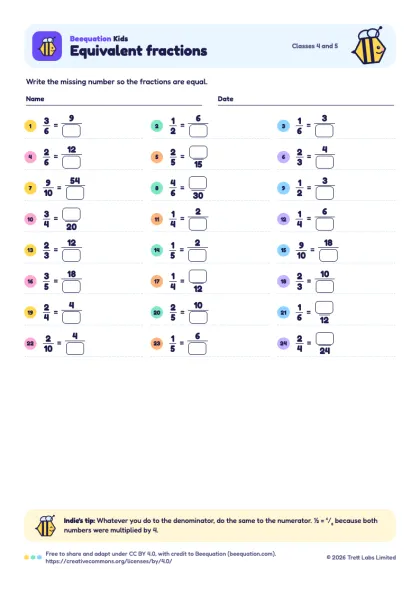 Equivalent fractionsClass 4, Class 5 · Find the missing numberDownload PDF
Braille (BRF) (2 KB) · Braille text (3 KB)
Questions parents and teachers ask
Pictures and equal sharing should give the words meaning. Introduce numerator and denominator when your child's book does (Class 5 in the NCERT books, earlier in many others), rather than making the names an early test.
A whole can be divided into four equal parts in different ways. The important check is that each part has the same amount, not that all dividing lines look alike.
Check the current school book. It often comes in Class 5, but books differ. The picture method above helps whenever it arrives.
Practise with Indie
Beequation Kids turns number facts into honeycomb puzzles, with Indie giving a hint when a child is stuck. No ads and no data collected.