 Beequation

Learn › Maths help by class › Class 2 maths
From counting to grouping
Class 2 maths
In Class 2, children begin to use groups rather than count everything one by one. A bundle of ten, a row of counters or an equal share can help them explain a calculation. Keep these practical models handy even when schoolwork in the copy looks more written.
Children are usually about 7 to 8. The NCERT book, Joyful Mathematics, works with numbers up to 100 in Class 2, while many private-publisher books go up to 999. The national NIPUN Bharat targets for Class 2 are reading and writing numbers up to 999, adding and subtracting numbers up to 99, seeing multiplication as repeated addition and division as equal sharing, and the tables of 2, 3 and 4. These are different reference points, not a reason to assume every Class 2 child has the same syllabus.
Understand tens and ones
Make 46 with four bundles of ten sticks and six loose sticks. Write 46 beside them. Ask what the 4 stands for: four tens, or forty, not four single sticks. Ask what changes if you add one loose stick, or another whole bundle. Our page on counting and place value has more ideas.
Use a number line to compare numbers, fill in missing numbers and talk about the number that comes before and after (some books say predecessor and successor). When comparing 46 and 64, look at the tens first. Six tens are more than four tens, even though 46 has more ones. Many books also put numbers in ascending and descending order, and sort them into even and odd.
If your child's book includes hundreds, use the same idea. In 345 there are three hundreds, four tens and five ones, and the expanded form is 345 = 300 + 40 + 5. Treat this as the next step when it is part of the school lesson, rather than making three-digit work a requirement for every child.
Add with carrying, subtract with borrowing
Your child's teacher may say “carry over” and “borrow”, or the newer word “regroup”, which the NCERT books use. They all describe the same idea: ten loose ones can become one bundle of ten, and one bundle of ten can be opened into ten ones. The amount stays the same. See addition and subtraction for the column methods.
Worked example: 36 + 27
Thirty-six is three tens and six ones. Twenty-seven is two tens and seven ones. Together there are five tens and thirteen ones. Bundle ten of those ones into another ten: that is the 1 your child carries over. Six tens and three ones make 63, so 36 + 27 = 63.
Worked example: 52 26
Make five tens and two ones. To take away six ones, open one ten: this is what “borrowing” means. You now have four tens and twelve ones. Take away two tens and six ones. Two tens and six ones remain: 52 26 = 26. Check by adding: 26 + 26 = 52.
Follow the layout shown by the teacher, with T and O written above the columns. If three-digit columns are in your child's book, use objects or a place-value drawing to explain the extra column.
Ask your child to estimate before calculating. For 36 + 27, an answer around sixty makes sense. An answer such as 513 suggests that the tens and ones need another look.
Equal groups and tables
Arrange twelve buttons in three rows of four. There are three equal groups, each with four buttons. Write 4 + 4 + 4 = 12 and connect it to 3 4 = 12. The sign gives a shorter way to record equal groups.
The NIPUN Bharat Class 2 target includes the tables of 2, 3 and 4. Many school books also practise the tables of 5 and 10, and many families start reciting more tables at home. Work with the tables your child's teacher has introduced. Counting in groups, arrays and repeated addition help the facts make sense before quick recall develops. Our multiplication and division page explains more.
Turn the button arrangement to see four rows of three. It still contains twelve buttons. Ask your child what has changed and what has stayed the same. This is a good start to understanding why 3 4 and 4 3 give the same answer.
Share fairly
Give three toy animals twelve counters to share. Your child can give each animal one counter at a time. Each receives four. Then ask whether the shares are equal and whether all twelve counters have been used.
There is another question hidden in the same collection: how many groups of four can you make from twelve? Make the groups and count them. Both experiences prepare children for division. The sign and written division come later (in Class 3 in the NCERT books), so fair sharing with objects is enough for now.
Measure, sort and describe
Compare lengths and begin using a scale (ruler) when it is introduced at school. Show that measuring starts at the zero mark, not necessarily at the end of the scale. Talk about centimetres and metres through familiar objects: a pencil, a door, the length of a room.
Use the words gram, kilogram, millilitre and litre with packets and containers. A 1 kg packet of atta and a 1 L water bottle give these units meaning. Don't expect conversions before the lessons introduce them. Our measurement page has more activities.
Describe shapes by their sides and corners. Turn a square on its corner and check that it is still a square. Tangram pieces can be arranged into different pictures while the pieces themselves stay the same. Sort objects by one feature, then try a different rule.
Money, time, data and patterns
In a pretend shop, buy something for ₹63 and pay with ₹100. Counting on from 63 to 100 gives ₹37 change: ₹7 reaches 70 and another ₹30 reaches 100. Check that ₹63 + ₹37 = ₹100. The NCERT Class 2 book also shows that 100 paise make ₹1, but everyday shopping work stays in whole rupees.
Use a calendar to name the months, find a date or count the days until a family event. Many books teach o'clock and half past in Class 2; move the hands on a model clock together (see telling the time). Record simple choices with tally marks or pictures and talk about which group has more. Continue repeating patterns and number patterns by explaining the rule, not guessing the next item.
By the end of Class 2, many children can…
- read, write and compare two-digit numbers, and three-digit numbers if their book teaches them;
- explain a two-digit number as tens and ones;
- add and subtract two-digit numbers, with carrying and borrowing, and check by adding;
- show multiplication as equal groups and say the tables they have practised;
- share a small collection equally;
- measure a short length in centimetres and read o'clock and half past on a clock.
Every child moves at their own pace. If one step isn't secure yet, go back to bundles and counters for a while.
Words your child will hear
Tens, ones, hundreds; expanded form; before, after, predecessor, successor; ascending, descending; even, odd; carry over, borrow, regroup; equal groups, times, tables; share; centimetre, metre; tally marks. In Hindi: हासिल (carrying), उधार (borrowing), पहाड़ा (times table).
Indie the honeybee can organise flowers in rows because she has already counted small collections carefully. If grouping is difficult for your child, revisit that earlier step. A little practical work can do more than another page of tables.
Indie's challengeIndie finds 47 flowers. By lunchtime she has visited 28. How many are still waiting? Show the answer
47 28 = 19. Take away twenty to get 27, then take away seven to reach 20 and one more to reach 19. Check: 28 + 19 = 47.
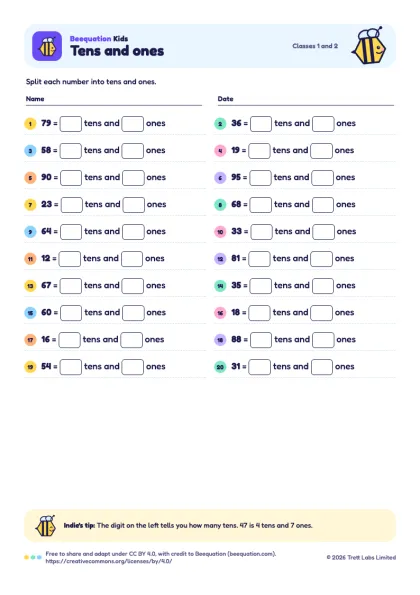 Tens and onesClass 1, Class 2 · Break two-digit numbers into tens and onesDownload PDF
Braille (BRF) (2 KB) · Braille text (4 KB)
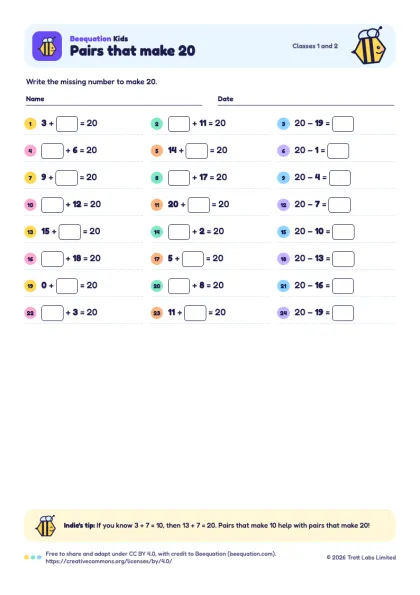 Pairs that make 20Class 1, Class 2 · Number pairs that add up to 20Download PDF
Braille (BRF) (1 KB) · Braille text (3 KB)
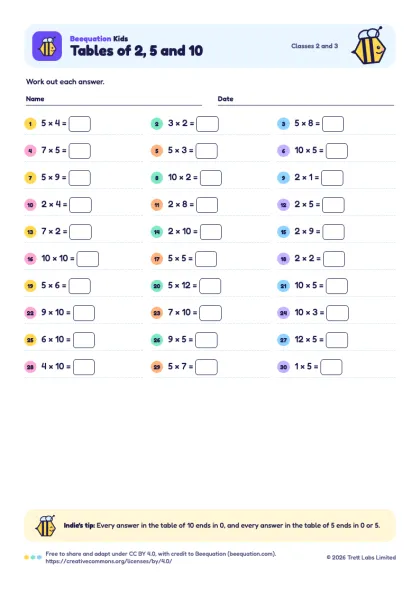 Tables of 2, 5 and 10Class 2, Class 3 · Mixed questions from the tablesDownload PDF
Braille (BRF) (2 KB) · Braille text (4 KB)
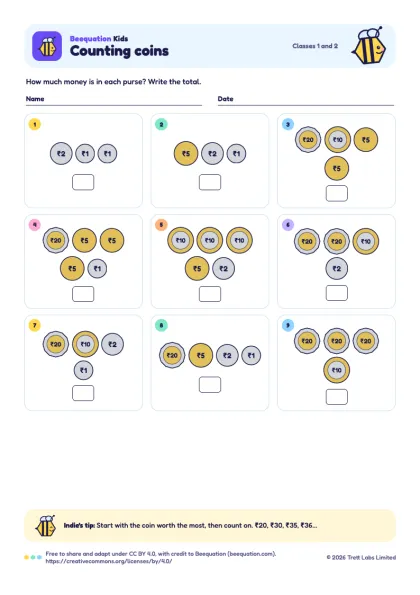 Counting coinsClass 1, Class 2 · Add up Indian coinsDownload PDF
Braille (BRF) (1 KB) · Braille text (3 KB) · Tactile pictures (PDF) (215 KB)
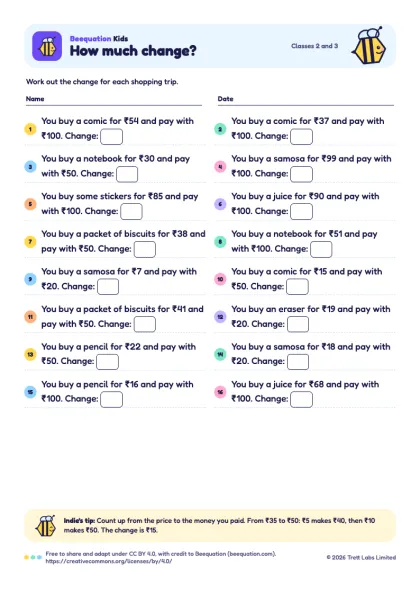 How much change?Class 2, Class 3 · Change from ₹20, ₹50 and ₹100Download PDF
Braille (BRF) (2 KB) · Braille text (5 KB)
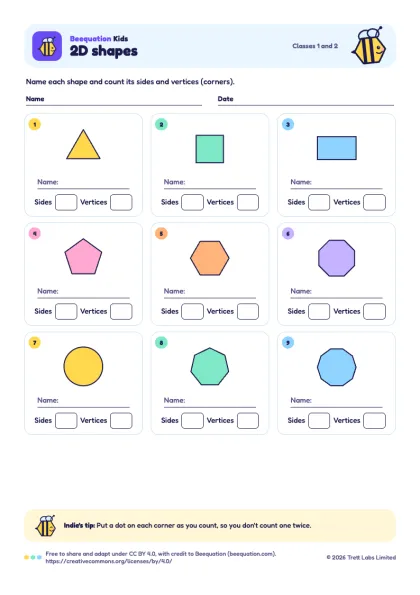 2D shapesClass 1, Class 2 · Names, sides and cornersDownload PDF
Braille (BRF) (2 KB) · Braille text (4 KB) · Tactile pictures (PDF) (77 KB)
Quick answers
Not necessarily. The NIPUN Bharat target for Class 2 is the tables of 2, 3 and 4, and many books add 5 and 10. Tables up to 10 are expected by the end of Class 3. Understanding equal groups first makes the tables easier to remember.
Both. The newer NCERT books say regroup; many teachers and parents still say carry over and borrow. Use the school's word in homework and explain that they mean the same thing.
Practise with Indie
Beequation Kids turns number facts into honeycomb puzzles, with Indie giving a hint when a child is stuck. No ads and no data collected.
Previous: Class 1 maths · Next: Class 3 maths · Ideas for helping at home.