 Beequation

Learn › Maths topics for Classes 1 to 5 › Decimals and percentages
Maths topics · Classes 1 to 5
Decimals and percentages
A child may see ₹25.50 on a price label before learning formal decimal arithmetic. Familiarity with that notation is useful, but it does not mean the child must already calculate with decimals or percentages.
The current NCERT books for Classes 1 to 5 don't teach decimals or percentages. Many private-publisher books do: decimals often start in Class 4 through money and measurement, and percentages in Class 5. Use the explanations here when they match your child's lessons, or as an optional exploration for a child who understands whole-number place value and fractions.
All shopping amounts on this page are made-up examples for practising maths, not current prices or offers.
Choose work that fits the child's class
- Class 1: build counting, comparison and whole numbers; no decimals.
- Class 2: strengthen tens and ones and practical money work in whole rupees.
- Class 3: explore equal parts, and rupees and paise where the book includes them.
- Class 4: tenths and hundredths through money (₹ and paise) and measurement (m and cm) in many private books.
- Class 5: tenths and hundredths, adding and subtracting decimals, and the first percentages in many private books.
There is no need to move ahead because another school teaches these ideas earlier. A secure understanding of fractions and place value gives later learning a stronger foundation.
Start with a familiar price
₹25.50 means 25 rupees and 50 paise. Since ₹1 = 100 paise, 50 paise is half a rupee. The two digits after the point in a money amount show paise.
₹25 and ₹25.00 name the same money amount. ₹25.50 is 50 paise more than ₹25. Read it as “twenty-five rupees fifty paise”; you may also hear “twenty-five fifty” at the shop.
Keep this explanation separate from formal calculations if your child's class is working only with whole rupees. Understanding a price label does not require a lesson on every decimal place.
Tenths are ten equal parts
For an optional decimal lesson, divide a strip into ten equal parts. Each part is one tenth, written or 0.1. Three shaded parts are three tenths: = 0.3. Read 0.3 as “zero point three”.
The first place to the right of the decimal point is the tenths place. In 2.5 (“two point five”), there are two ones and five tenths. Five tenths is half a whole, so 2.5 means two and a half.
On a number line, 0.5 lies halfway between 0 and 1. Make ten equal spaces, not ten marks: the endpoints and the nine marks between them create ten spaces.
Hundredths are smaller equal parts
Divide a whole into 100 equal squares. One square is one hundredth, written or 0.01. Twenty-five squares make = 0.25, which is one-fourth.
Ten hundredths make one tenth: 0.10 = 0.1. A zero at the end of a decimal's fractional part does not change its value. A zero in a different position can matter: 0.05 is five hundredths, while 0.5 is five tenths.
In 3.47, the digits represent 3 ones, 4 tenths and 7 hundredths. Read the decimal as “three point four seven” to keep each place clear.
Compare values, not the number of digits
Which is greater: 0.3 or 0.25? Write three tenths as thirty hundredths: 0.3 = 0.30. Thirty hundredths is more than twenty-five hundredths, so 0.3 > 0.25.
The answer is not decided by which number has more digits. Use a hundred square to show 30 shaded squares beside 25. Ask your child to explain the comparison before practising more examples.
When your child compares decimals, ask them to give both numbers the same number of decimal places first: 0.3 and 0.30 are the same amount, even though one has an extra digit.
Connect decimals with measurement
A metre contains 100 centimetres. Therefore 2.5 m is 2 metres and half a metre: 200 cm + 50 cm = 250 cm. The unit is part of the answer.
When multiplying or dividing by 10 or 100, think about place value. Multiplying 0.25 by 100 gives 25; dividing 25 by 100 gives 0.25. The digits take places worth more or less while the decimal point marks the boundary between ones and tenths.
Avoid teaching this as moving the decimal point without explanation. Ask, “Has the amount become larger or smaller? Which place should this digit occupy?”
Percentage means out of one hundred
A percentage describes an amount relative to a whole divided into 100 equal parts. Fifty out of 100 is 50%, which is one half. Twenty-five out of 100 is 25%, which is one-fourth. Ten out of 100 is 10%, which is one tenth.
Read 25% as “twenty-five per cent”. These are useful connections:
- 50% = = = 0.5.
- 25% = = = 0.25.
- 10% = = = 0.1.
The whole must be stated. Half of 20 is 10; half of 40 is 20. Both answers represent 50%, but the quantities differ because the starting amounts differ.
Find an amount and a discount
To find 25% of ₹200, take one-fourth: ₹200 4 = ₹50. A 25% discount on this fictional price reduces it by ₹50, leaving ₹150 to pay.
To find 10% of ₹450, take one tenth: ₹450 10 = ₹45. A 10% discount leaves ₹450 ₹45 = ₹405. The discount is ₹45; the amount paid is ₹405. They answer different questions.
Activities without rushing ahead
- Read a sample bill and explain rupees and paise without adding amounts yet.
- Shade tenths on a strip, then find the matching decimal card.
- Shade 25 and 50 squares on separate hundred squares.
- Compare pairs such as 0.5 and 0.05 with drawings.
- Let students write a discount question and label both the saving and the final price.
Indie's challengeIn a made-up offer, a bag costing ₹320 has a 25% discount. How much is saved, and how much is paid? Show the answer
25% is one-fourth. ₹320 4 = ₹80 is saved. ₹320 ₹80 = ₹240 is paid.
Free decimals and percentages worksheets
These sheets go beyond the NCERT primary books. Use them when they match your child's book and understanding.
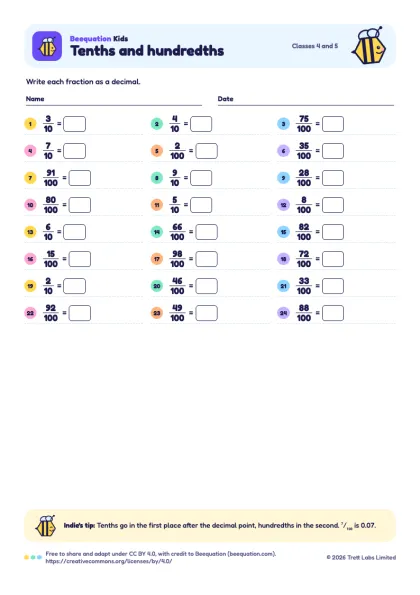 Tenths and hundredthsClass 4, Class 5 · Fractions as decimalsDownload PDF
Braille (BRF) (1 KB) · Braille text (3 KB)
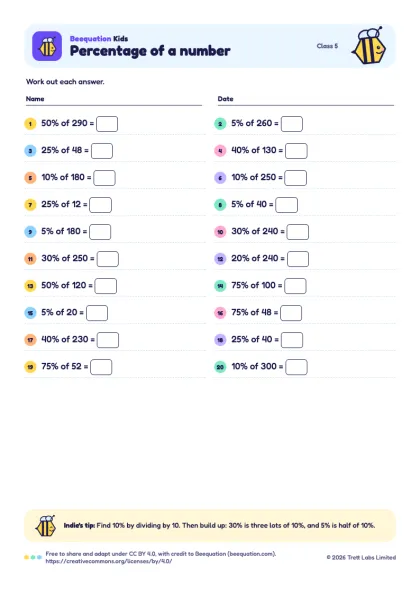 Percentage of a numberClass 5 · 10%, 25%, 50% and moreDownload PDF
Braille (BRF) (1 KB) · Braille text (3 KB)
Questions parents and teachers ask
Not in the current NCERT books for Classes 1 to 5. Many private-publisher books start percentages in Class 5; others leave them to Class 6. Check your child's own textbook.
Three tenths equals thirty hundredths. Thirty equal parts are more than twenty-five parts of that same size.
Money is a useful starting point, but strips, hundred squares and measurement help children understand decimals beyond rupees and paise.
Practise with Indie
Beequation Kids turns number facts into honeycomb puzzles, with Indie giving a hint when a child is stuck. No ads and no data collected.