 Beequation

Learn › Maths topics for Classes 1 to 5 › Money
Maths topics · Classes 1 to 5
Money
Buying a pencil, reading a canteen price list or saving in a gullak gives children a reason to use maths. Money brings together counting, place value, addition, subtraction and, later, multiplication and division. Start with amounts your child can represent with counters or paper coins, rather than a long written bill.
The prices on this page are made-up examples for practice, not current shop prices. Use your child's textbook to decide when to introduce amounts containing paise. Reading ₹25.50 on a bill need not turn into a formal lesson on decimal arithmetic.
Money across Classes 1 to 5
- Class 1: recognise coins and notes, and count small amounts with objects and pictures.
- Class 2: make whole-rupee amounts in different ways and solve small shopping problems; the NCERT book also shows that 100 paise make ₹1.
- Class 3: rupees and paise, bills, and working out change.
- Class 4: bills and rates (“1 kg costs ₹40; how much for 3 kg?”).
- Class 5: several purchases and unit prices; the unitary method and money as decimals in many private books.
This is a broad guide, not a fixed chapter order for every school. The current NCERT books for Classes 1 to 5 don't teach decimals or percentages; if your child's book does, see decimals and percentages.
Rupees, paise and values
₹ is the rupee symbol. Write ₹50, with the symbol before the number. One rupee is equal to 100 paise. An amount of ₹25.50 means twenty-five rupees and fifty paise; it does not mean twenty-five rupees and five paise.
The coins in use are 50 paise, ₹1, ₹2, ₹5, ₹10 and ₹20. The ₹20 coin has 12 sides. In the coin series introduced in 2019, size and weight increase with value, which helps people who are blind or partially sighted. The notes are ₹10, ₹20, ₹50, ₹100, ₹200 and ₹500; notes of ₹100 and above have a raised mark you can feel. Use drawn coins or play money for practice. Coins of 25 paise and below are no longer legal tender, so leave them out.
Ask your child to read a value before adding it. Five coins do not necessarily have a total value of ₹5: five ₹2 coins make ₹10. Distinguishing the number of coins from their total value is an important early step.
Make the same amount in different ways
Put out paper coins marked ₹1, ₹2 and ₹5. Ask, “How could you pay exactly ₹10?” Accept several combinations:
- ₹5 + ₹5 = ₹10
- ₹2 + ₹2 + ₹2 + ₹2 + ₹2 = ₹10
- ₹5 + ₹2 + ₹2 + ₹1 = ₹10
Then ask which combination uses fewer coins. Two ₹5 coins use fewer coins than five ₹2 coins, but both pay the same amount. Let your child rearrange the coins and check that their value has not changed.
Show your child how to put the larger coins and notes down first, then check what is still needed. Treat it as a starting strategy, not a rule that there is only one correct way to pay.
Add a small bill
Suppose a notebook costs ₹28 and a pencil costs ₹7. The total is ₹28 + ₹7. Count on ₹2 to reach ₹30, then add the remaining ₹5: the bill is ₹35.
For three purchases, look for a helpful pair. A folder at ₹35, an eraser at ₹5 and crayons at ₹24 give:
₹35 + ₹5 = ₹40
₹40 + ₹24 = ₹64
Ask for an estimate before accepting the exact total. The folder and eraser together cost ₹40, and the crayons cost a little more than ₹20, so a bill of ₹64 is sensible. ₹640 would not be.
Find change by counting up
A customer pays ₹100 for a purchase costing ₹63. Change is the difference between the payment and the cost.
Count up from ₹63 to ₹70: ₹7.
Count up from ₹70 to ₹100: ₹30.
₹7 + ₹30 = ₹37 change.
Check with the inverse: ₹63 + ₹37 = ₹100. Written subtraction, ₹100 ₹63, gives the same answer. Counting up is particularly useful when a subtraction crosses zeros.
Keep the roles clear in a pretend shop. The buyer gives the payment; the shopkeeper returns the change. If the purchase is ₹63 and the buyer pays ₹60, there is no change to return: the buyer still needs ₹3.
Connect price and quantity
If one kilogram of tomatoes costs ₹40 in our practice shop, three kilograms cost 3 ₹40 = ₹120. Here ₹40 is the price per kilogram. It is not the price of the whole purchase.
If five identical pens cost ₹50, divide to find the cost of one (books call this the unitary method): ₹50 5 = ₹10. Three pens at that same unit price cost 3 ₹10 = ₹30. Explain both steps, rather than multiplying ₹50 by 3.
Real packs and offers may have different prices. The maths example assumes each pen has the same unit price; do not treat that assumption as a claim about every shop.
Rupees and paise, when the book includes them
For an additional rupee-and-paise example, add ₹25.50 and ₹14.75. Add the paise: 50 + 75 = 125 paise, which is ₹1 and 25 paise. Add the rupees: ₹25 + ₹14 + ₹1 = ₹40. The total is ₹40.25.
Check it another way: ₹25.50 + ₹14.50 = ₹40, followed by the remaining 25 paise. If your child has not studied these amounts, stay with whole rupees and return to this later.
Common mistakes to watch for
- Counting coins without reading their values.
- Giving the purchase price as the change.
- Adding the payment and cost when the question asks for their difference.
- Reading ₹8.05 as eight rupees and fifty paise. It is eight rupees and five paise.
- Leaving out the unit in a rate, such as ₹40 per kilogram.
Practise at home or in class
- Kirana counter: label three empty packets with whole-rupee prices. Take turns buying two items and checking the bill.
- Exact payment: choose a target such as ₹12 and find three different coin combinations.
- Gullak record: record pretend savings over a week and add the amounts. No personal money information is needed.
- Sabzi shopping: use a made-up price per kilogram and compare the cost of one, two and three kilograms.
- Payment screen: discuss the amount on a drawn digital-payment screen. A digital payment changes how money is paid, not the arithmetic of the bill.
Indie's challengeIndie buys a notebook for ₹28 and crayons for ₹35. She pays ₹100. How much change should she get? Show the answer
The total is ₹28 + ₹35 = ₹63. ₹100 ₹63 = ₹37, so Indie should get ₹37 change. Check: ₹63 + ₹37 = ₹100.
Free money worksheets
Use the coin sheet for recognising values, then the change sheet when subtraction is familiar. Read the amounts together before your child begins.
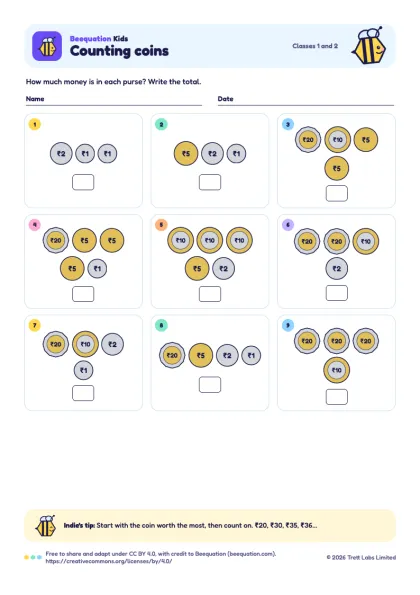 Counting coinsClass 1, Class 2 · Add up Indian coinsDownload PDF
Braille (BRF) (1 KB) · Braille text (3 KB) · Tactile pictures (PDF) (215 KB)
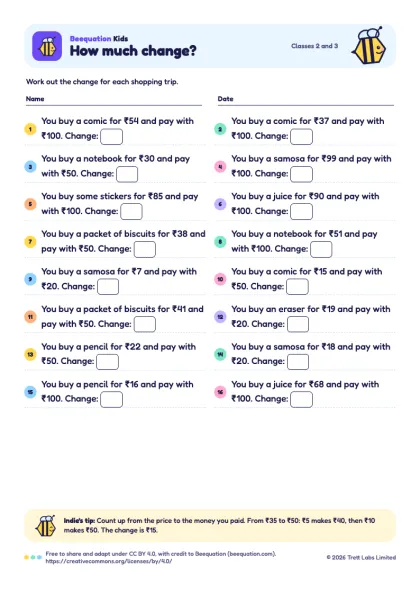 How much change?Class 2, Class 3 · Change from ₹20, ₹50 and ₹100Download PDF
Braille (BRF) (2 KB) · Braille text (5 KB)
Questions parents and teachers ask
No. Paper coins with clearly written values work well. Explain that they are representations for maths, not money to spend.
No. Counting up and written subtraction are both valid. Ask your child to explain the difference and check that cost plus change equals payment.
Only if your child's book or teacher includes them. Whole-rupee bills, change and unit prices already provide useful primary maths practice.
Practise with Indie
Beequation Kids turns number facts into honeycomb puzzles, with Indie giving a hint when a child is stuck. No ads and no data collected.