 Beequation

Learn › Maths topics for Classes 1 to 5 › Shapes and geometry
Maths topics · Classes 1 to 5
Shapes and geometry
A floor tile, a box and a rangoli pattern invite children to notice shape. Geometry begins with handling, sorting, drawing and describing, not with memorising names from one picture. Encourage your child to explain what stays the same when a shape is turned or made larger.
Use several examples of each shape. A triangle pointing down is still a triangle, and a tall, narrow rectangle is still a rectangle. Children learn more from comparing examples than from seeing only one familiar outline.
Geometry across Classes 1 to 5
- Class 1: solid objects that roll or slide; circles, triangles, squares and rectangles; straight and curved lines.
- Class 2: sides and corners of flat shapes, cubes, cylinders and other solids, tangrams and shape patterns.
- Class 3: faces, edges and corners; kinds of lines; symmetry; tangrams and tiling.
- Class 4: circles (centre, radius, diameter) with a compass, nets, top and side views, and angles as turns.
- Class 5: right, acute and obtuse angles, symmetry, nets and maps.
This is a broad guide, not a fixed chapter order. The NCERT books for Classes 4 and 5 name right, acute and obtuse angles and talk about quarter turns, but they don't measure angles in degrees or use a protractor. Many private-publisher books do both in Class 5.
Flat shapes and solid objects
A flat shape has an outline that can be drawn on paper. A triangle has three straight sides and three corners; a rectangle has four straight sides and four square corners. A square is a rectangle with all four sides equal. Avoid teaching that squares and rectangles are completely unrelated groups.
A circle has a curved boundary and no corners. It is not a many-sided polygon. Trace a circular lid, then compare the flat drawing with the solid lid itself.
Solid objects occupy space. A cube has six square faces, 12 edges and eight corners. A cuboid has six rectangular faces; some of those faces may be squares. Use boxes to point out a face, an edge where faces meet and a corner where edges meet.
Compare a ball, a box and a cylinder-shaped container on a level surface. A ball can roll; a box can slide. A cylinder can roll on its curved surface and slide on a flat end. What happens depends on how the object is placed, so do not assign “roll” or “slide” without trying it.
Name a shape from its properties
Draw a triangle with three unequal sides, then another with equal sides. Both belong to the triangle family because both have three straight sides and three corners.
Turn a square so that a corner points upwards. Its four equal sides and four square corners have not changed. Calling it a “diamond” describes a familiar appearance, but does not replace its mathematical name.
Ask, “What makes you sure?” Useful answers refer to sides, corners, equal lengths or square corners. “It looks like the picture in my book” is a starting observation; help your child move from appearance to properties.
Give your child the corner of a postcard or a folded sheet of paper to test for a square corner (a right angle). It checks the angle itself, whichever way the drawing is turned.
Symmetry: matching by folding
A line of symmetry divides a shape so that the two parts match when folded along that line. Cut out a rectangle that is not a square. Fold it through the midpoints of opposite sides: the halves match. Fold along a diagonal: they do not.
A non-square rectangle has two lines of symmetry. A square has four: two through opposite side midpoints and two diagonals. A circle has a line of symmetry through its centre in every direction.
Use a mirror or folding to check, rather than assuming that any line making two equal-sized parts is a symmetry line. Equal area alone is not enough; the shapes must match under reflection.
Rangoli, kolam and pookalam designs are lovely patterns to discuss. Some designs have symmetry and others do not. Look at the particular design instead of making a claim about every example.
Tiling and making new shapes
Tiling covers a surface without gaps or overlaps. Try paper squares, rectangles and regular hexagons. Squares fit around a point without leaving a gap. Regular hexagons also fit together, like a honeycomb pattern.
Try equal circles next. Even when their edges touch, spaces remain between them. This comparison helps children distinguish a repeated arrangement from a tiling.
With a tangram or other cut-out pieces, make a larger shape and describe the pieces used. Two matching right-angled triangles can form a rectangle if joined along their sloping sides in the appropriate arrangement. Rotate and rearrange the pieces to check the result.
Circles: centre, radius and diameter
The centre is the point equally distant from the circle's boundary. A radius joins the centre to a point on that boundary. A diameter joins two points on the boundary and passes through the centre.
A diameter is twice a radius. If a circle has radius 3 cm, its diameter is 6 cm. A straight line across a circle that misses the centre is not a diameter.
When your child's book introduces the compass from the geometry box, show how the point stays at the centre while the pencil traces the boundary. Changing the opening changes the radius. Supervise the pointed tool and give children time to practise the movement before asking for an accurate drawing.
Turns and angles
Stand facing the classroom board. A quarter turn to the right changes the direction to your right-hand side. A half turn faces the opposite direction. Four quarter turns in the same direction bring you back to the starting direction.
A right angle is the square corner made by a quarter turn. An acute angle is smaller than a right angle; an obtuse angle is larger than a right angle but smaller than a straight angle. Compare openings with a folded-paper right angle.
The length of the drawn arms does not decide the angle size. Two angles with the same opening remain equal even if one drawing has longer arms. Keep comparison practical; degree measurements can wait until they are taught.
Nets and different views
A net is a flat arrangement of faces that can fold into a solid. A cube net needs six squares, but not every arrangement of six squares folds into a cube: faces may overlap or leave a gap.
Use a paper net from the textbook and predict which faces will meet before folding. Then check the prediction. A model provides stronger evidence than guessing from the flat picture.
Build a small arrangement of blocks and draw it from the front, side and above. A top view may hide some blocks beneath others. Ask which features can be seen from each position, not only how many blocks appear in one drawing.
Five-minute games for home
- Shape hunt: find rectangular faces and circular outlines at home, such as a tiffin box, a bangle or a tile, and tell the object apart from the shape of one face.
- Odd one out: offer four shapes and accept different answers when the property is explained.
- Fold and check: test a proposed symmetry line before drawing it.
- Turn instructions: give a partner a quarter-turn or half-turn instruction and compare starting and finishing directions.
- Build and view: photograph or sketch a block model from three positions.
Indie's challengeIndie draws a circle with a radius of 4 cm. What is its diameter, and must a diameter pass through the centre? Show the answer
The diameter is twice the radius: 2 4 cm = 8 cm. Yes, a diameter must pass through the centre and have both endpoints on the circle's boundary.
Free shape worksheets
Turn some of the pictures before naming them. Ask your child to explain a property as well as write a name.
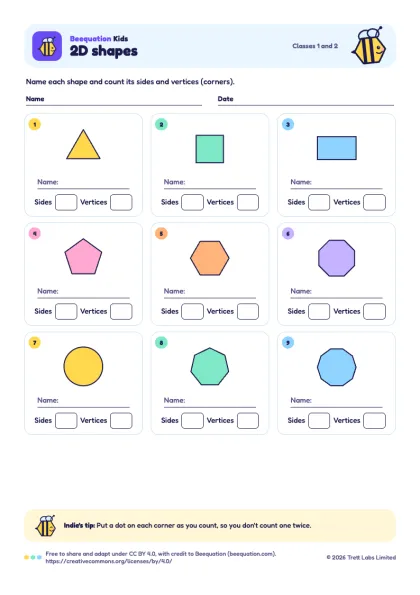 2D shapesClass 1, Class 2 · Names, sides and cornersDownload PDF
Braille (BRF) (2 KB) · Braille text (4 KB) · Tactile pictures (PDF) (77 KB)
Questions parents and teachers ask
Yes. It has four right angles, like every rectangle, and additionally all four sides are equal. It helps to show a square as a special rectangle.
No. The halves must match when reflected across the proposed line. Fold or use a mirror to check.
Follow the textbook and teacher. Many private books bring in the protractor in Class 5; the NCERT books don't use one in Classes 1 to 5. Comparing angles and recognising turns are worthwhile without measuring in degrees.
Practise with Indie
Beequation Kids turns number facts into honeycomb puzzles, with Indie giving a hint when a child is stuck. No ads and no data collected.