 Beequation

Learn › Maths topics for Classes 1 to 5 › Counting and place value
Numbers that make sense
Counting and place value
Place value explains why the 5 in 52 means fifty, while the 5 in 25 means five. It also explains the zero in 305 and what happens when children regroup during a calculation. Begin with collections children can handle, then connect those collections to pictures and written numbers.
At home, bundle ice-cream sticks or matchsticks with a rubber band. In school, use a place-value chart and counters. Ask children to show a number in more than one way, not only to name the columns.
How the ideas grow
- Class 1: count collections, match numerals to quantities, numbers to 99 or 100, and tens and ones with bundles and sticks.
- Class 2: numbers to 100 in the NCERT book and to 999 in many private books; hundreds, tens and ones; expanded form; even and odd.
- Class 3: numbers to 1,000 in the NCERT book and to 9,999 in many private books; the signs > and <; face value and place value in private books.
- Class 4: thousands and the Indian place value chart; five-digit numbers and rounding off in many books.
- Class 5: five-digit numbers (ten thousands) in the NCERT book; lakhs and crores, and often the international system, in many private books.
The national NIPUN Bharat targets are reading and writing numbers up to 99 in Class 1, up to 999 in Class 2 and up to 9,999 in Class 3. The order varies across school books. Larger numbers are no reason to rush past counting and grouping.
Counting is more than saying numbers
One object, one number
Ask your child to move each object into a new space while counting it. This helps them avoid counting one object twice or missing another. When they finish, ask, “How many altogether?” The last number said gives the total.
Spread the same objects out and ask whether the total has changed. A longer row does not necessarily contain more objects. Let the child count or match them to check rather than expecting them to accept your answer.
Make groups of ten
For 34 sticks, make three bundles of ten and leave four loose. Say “3 tens and 4 ones”, then write 34. Ten ones can be exchanged for one ten without changing the total. This exchange is the basis of regrouping.
Read the columns, including zero
Hundreds, tens and ones
In 472, the 4 means 400, the 7 means 70 and the 2 means 2. The expanded form is 400 + 70 + 2. Ask children to build it before asking them to write the expanded form.
A number can also be regrouped. For example, 34 is 3 tens and 4 ones, or 2 tens and 14 ones. Both represent the same quantity. This flexibility helps children understand subtraction later.
Face value and place value
Your child's book may ask for the face value and the place value of a digit. The face value is the digit itself; the place value is what it is worth in its position. In 4,582, the face value of 5 is 5 and its place value is 500. Many private-publisher books use these words; the NCERT books describe the same idea without the term “face value”. In Hindi, place value is स्थानीय मान.
Zero keeps a place
In 305, there are 3 hundreds, no tens and 5 ones. Without the zero, 35 would mean 3 tens and 5 ones. Zero is not decoration: it tells us that a column has no units of that size.
In 7,052, there are 7 thousands, no hundreds, 5 tens and 2 ones. Read it as “seven thousand fifty-two”. In 3,052, the 3 has a value of 3,000; the other columns have the same values as before.
Compare from the largest place
To compare 684 and 648, look at hundreds first. Both have 6 hundreds. Compare tens next: 8 tens is more than 4 tens, so 684 > 648. There is no need to compare the ones once the tens decide the result.
When using > and <, read the whole statement aloud. “684 is greater than 648” is more useful than remembering a picture of a hungry mouth without knowing the numbers.
Keep the place-value chart and the collection beside each other. Ask “What does this digit stand for here?” rather than asking only for the column name.
Indian number grouping
For five-digit numbers, write 10,458 and read “ten thousand four hundred fifty-eight”. In the Indian system, the first comma comes before the last three digits and then a comma comes after every two digits: 1,000, then 10,000, then 1,00,000.
1,00,000 is one lakh and 1,00,00,000 is one crore. The number 3,45,672 is read “three lakh forty-five thousand six hundred seventy-two”. Many private-publisher books teach lakhs and crores in Class 5, often with the international system (10 lakh = 1 million). The current NCERT Class 5 book stops at five-digit numbers, so follow your child's book.
Common difficulties
- Counting a scattered collection twice: move each counted object into a separate space.
- Writing 3005 for three hundred five: build 305 in a chart and read each column.
- Comparing only the last digit: compare from the largest place.
- Thinking a bundle counts as one: open it and count the ten sticks again.
- Assuming more spread-out objects means more: match objects one to one.
Five-minute games for home
- Count and rearrange: count 18 counters, rearrange them and predict the total.
- Bundle shop: exchange ten loose sticks for a bundle, then make a given number.
- Build my number: say “4 hundreds, 0 tens, 6 ones” and ask for a model and numeral.
- Digit swap: compare 36 and 63. Explain what changed when the digits moved.
- Between two numbers: find a number between 450 and 500 and explain the choice.
Indie's challengeUse the digits 3, 0, 7 and 5 once each. What are the greatest and smallest four-digit numbers you can make? Show the answer
The greatest is 7,530: put the digits in descending order. The smallest is 3,057: the thousands digit cannot be zero, so use the smallest non-zero digit first, then the remaining digits in ascending order. A number beginning with zero would not be a four-digit number.
Free counting and place value worksheets
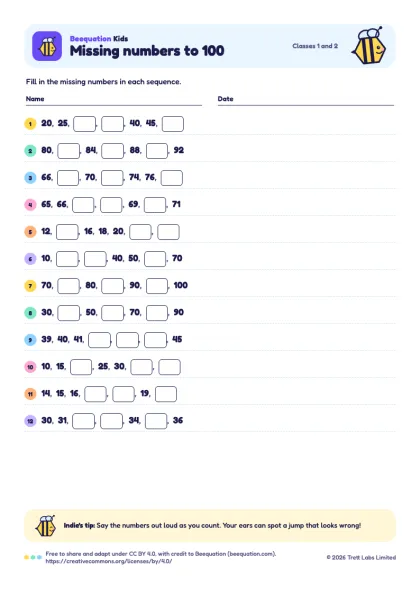 Missing numbers to 100Class 1, Class 2 · Count in 1s, 2s, 5s and 10sDownload PDF
Braille (BRF) (1 KB) · Braille text (3 KB)
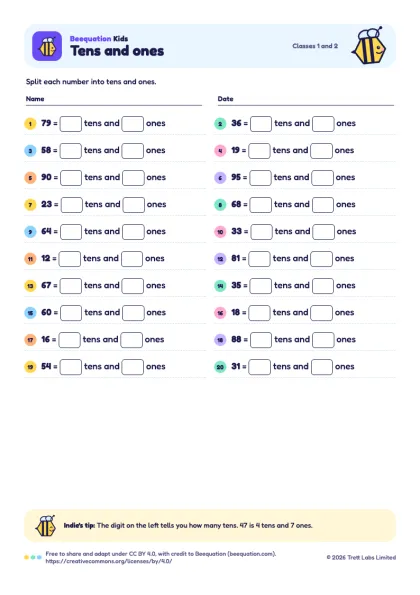 Tens and onesClass 1, Class 2 · Break two-digit numbers into tens and onesDownload PDF
Braille (BRF) (2 KB) · Braille text (4 KB)
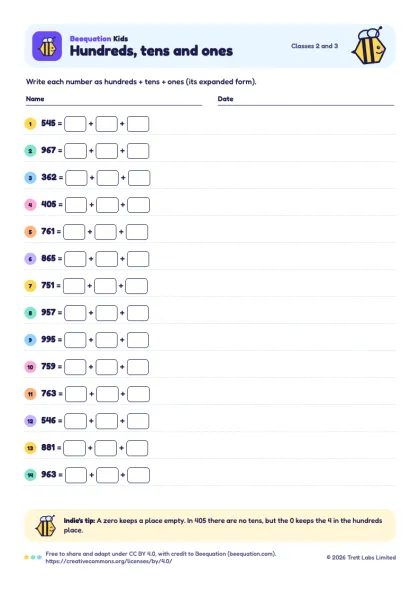 Hundreds, tens and onesClass 2, Class 3 · Place value up to 999Download PDF
Braille (BRF) (2 KB) · Braille text (3 KB)
Questions parents and teachers ask
When finding the total of a new collection, counting from 1 is useful. As number understanding grows, practise counting on from a known number too. Knowing that there are already 10 objects lets a child count 11, 12, 13 for three more.
Follow the child's textbook; many books start rounding off to the nearest 10 and 100 in Class 3 or 4. First make sure they can place numbers between neighbouring tens or hundreds. If rounding is introduced, use distance on a number line to explain the choice rather than a rule alone.
No. A child who can explain 34 in several ways is building a useful foundation. Increase the number range when the underlying idea is secure.
Practise with Indie
Beequation Kids turns number facts into honeycomb puzzles, with Indie giving a hint when a child is stuck. No ads and no data collected.