 Beequation

Learn › Maths help by class › Class 3 maths
Explain how the numbers work
Class 3 maths
Class 3 is the first year of the Preparatory Stage (Classes 3 to 5). Children are usually about 8 to 9 and do more written work, but objects, drawings and conversation still matter. A correct answer is useful; understanding how it was found is what helps with the next problem.
The NCERT book for Class 3 is Maths Mela, which works with numbers up to 1,000. Many private-publisher books go further, up to 9,999. The national NIPUN Bharat mission aims for children to read and write numbers up to about 9,999 and to add, subtract and begin to multiply confidently by the end of Class 3. Check your child's book before choosing practice.
Use place value to read and compare
In 608, the 6 stands for six hundreds, the 0 shows there are no tens and the 8 stands for eight ones. Write 608 = 600 + 8. The zero holds the tens place; leaving it out would give 68, a different number. More on this in counting and place value.
Compare 608 and 680 by looking first at the hundreds and then the tens. Both have six hundreds, but eight tens are more than no tens, so 680 > 608. The signs > and < appear in the NCERT Class 3 book. Read the whole statement aloud, “680 is greater than 608”, so the sign has meaning.
Practise counting forwards and backwards across a hundred, such as 298, 299, 300, 301. If your child's book goes to 9,999, extend the place-value chart to thousands (Th H T O) in the same way. Many private books also ask for the face value and place value of a digit: in 4,582, the face value of 5 is 5 and its place value is 500.
Add and subtract three-digit numbers
Keep hundreds, tens and ones lined up in written sums. Carrying and borrowing (your child's book may say regrouping) change how a number is shown, not its value: ten ones can become a ten, and ten tens can become a hundred. See addition and subtraction for the column layouts.
Worked example: 347 + 285
The ones give 7 + 5 = 12: write 2 in the ones and carry 1 ten. The tens give 4 + 8 + 1 = 13 tens: write 3 in the tens and carry 1 hundred. The hundreds give 3 + 2 + 1 = 6. The total is 632. Check another way: 347 + 200 + 80 + 5 = 547 + 80 + 5 = 632.
Worked example: 500 278
This is borrowing across zeros. Think of 500 as five hundreds. Change one hundred into ten tens, then one of those tens into ten ones. You now have four hundreds, nine tens and ten ones. Take away two hundreds, seven tens and eight ones. Two hundreds, two tens and two ones remain: 222. Check: 278 + 222 = 500.
When a zero appears in a subtraction, draw the borrowing first. Crossing out digits without knowing what they stand for can hide a misunderstanding.
Build tables from known facts
Tables of 2 to 10 support much of the year's multiplication and division, and they are part of the NIPUN Bharat goals for the end of Class 3. Many schools go further; that is a school choice rather than a reason to rush past understanding. Ask mixed questions as well as reciting a table in order.
For 6 7, use five groups of seven and one more group: 35 + 7 = 42. For 8 4, double 4 4: 16 + 16 = 32. Draw arrays to check the groups. Talk about multiplying by 1, multiplying by 0, and the pattern when multiplying by 10 or 100.
Children can extend equal groups to two- or three-digit numbers multiplied by one digit. For example, 23 4 is twenty times four plus three times four: 80 + 12 = 92. Use the written method your child's teacher expects, while keeping this meaning visible. Our multiplication and division page has more.
Connect division with multiplication
In the NCERT book, the sign arrives in Class 3. Division can mean sharing into a given number of equal groups or finding how many groups of a given size fit. For 42 6, ask how many groups of six make forty-two. Since 6 7 = 42, the answer is 7. Teachers call these “division facts”.
Not every collection divides equally. Share seventeen counters between four toys. Each gets four and one remains: 17 4 gives quotient 4 and remainder 1. Check with 4 4 + 1 = 17. Discuss what the remainder means in the story: a leftover counter is different from a roti that can be cut and shared.
Explore familiar fractions
Fold a paper circle into two equal parts. Each part is one-half. Fold another into four equal parts. Each is one-fourth, or a quarter, and three of those parts make three-fourths. The parts must be equal: any two pieces don't automatically make halves. See fractions for pictures.
Children also find fractions of a collection. Half of twelve buttons is six, because twelve shared into two equal groups gives six in each. One-fourth of twelve is three. Keep the whole clear: half of a small roti and half of a large roti are the same fraction, but not the same amount of food.
The NCERT Class 3 book teaches halves and quarters through sharing and leaves the words numerator and denominator for Class 5. Many private books use those words already in Class 3. Follow your child's book.
Measure, tell the time and use money
Use centimetres and metres for length, grams and kilograms for weight, and millilitres and litres for capacity. A scale, a packet label and a measuring jug connect the units to real quantities. Choose sensible units: a pencil's length is better described in centimetres than kilometres. Simple conversions such as 1 m = 100 cm and 1 kg = 1,000 g come up this year in many books.
The NCERT Class 3 book reads times such as “8:15 or quarter past 8” and “8:30 or half past 8”, and many books go on to five-minute steps. From 3:15 to 3:45 is thirty minutes. Move the hands on a model clock or mark the interval on a timeline to check.
Read small bills, add costs and work out change. Three notebooks at ₹20 each cost ₹60. Paying ₹100 leaves ₹40 change. Ask your child to check both the multiplication and the change, and to write ₹ in the final money answer. Many books bring in rupees and paise this year.
Shapes, maps and data handling
Describe flat shapes and solid objects. A box has faces, edges and corners; a drawing of a rectangle is flat. Explore symmetry by folding a picture, a rangoli design or a paper butterfly and looking for matching halves. Follow a simple map of the classroom using landmarks and directions.
Make tally marks or a pictograph of favourite fruits. If one picture stands for more than one child, read its key carefully. Ask what the information shows and what it doesn't tell you. Some books also start simple bar graphs this year.
By the end of Class 3, many children can…
- read, write and compare numbers up to 1,000, or up to 9,999 if their book goes that far;
- add and subtract three-digit numbers with carrying and borrowing, and check the answer;
- use the tables of 2 to 10 and the division facts that go with them;
- find one-half, one-fourth and three-fourths of a shape or a collection;
- measure in cm and m, g and kg, mL and L;
- read the clock to the hour and half hour, and often to quarter past and quarter to.
These are broad goals, not a test. Children who need more time with one idea are not unusual at this age.
Words your child will hear
Thousands, hundreds, tens, ones; face value, place value; greater than, less than; carry, borrow, regroup; product; divide, quotient, remainder; half, one-fourth (quarter), three-fourths; centimetre, metre, gram, kilogram, millilitre, litre; line of symmetry; pictograph, key. In Hindi: भागफल (quotient), शेषफल (remainder), आधा (half), चौथाई (quarter).
Indie the honeybee checks a division by multiplying. Encourage your child to choose a check that fits the calculation rather than repeating the same steps without looking for errors.
Indie's challengeIndie visits 6 rows of flowers, with 7 flowers in each row. How many flowers does she visit? Show the answer
6 7 = 42. Five rows contain 35 flowers and one more row contains seven: 35 + 7 = 42. Count the array or use 42 6 = 7 to check.
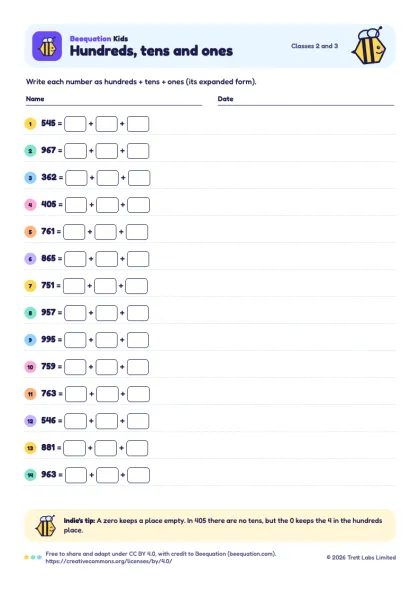 Hundreds, tens and onesClass 2, Class 3 · Place value up to 999Download PDF
Braille (BRF) (2 KB) · Braille text (3 KB)
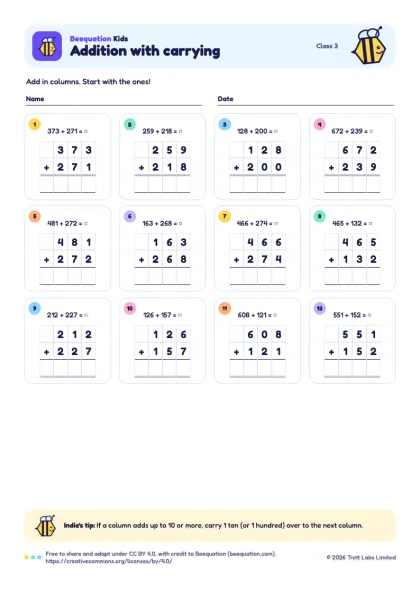 Addition with carryingClass 3 · Three-digit numbers in columns, with carryingDownload PDF
Braille (BRF) (1 KB) · Braille text (3 KB)
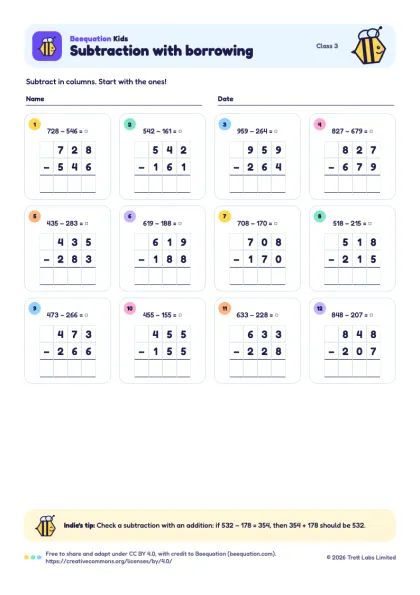 Subtraction with borrowingClass 3 · Three-digit numbers in columns, with borrowingDownload PDF
Braille (BRF) (1 KB) · Braille text (3 KB)
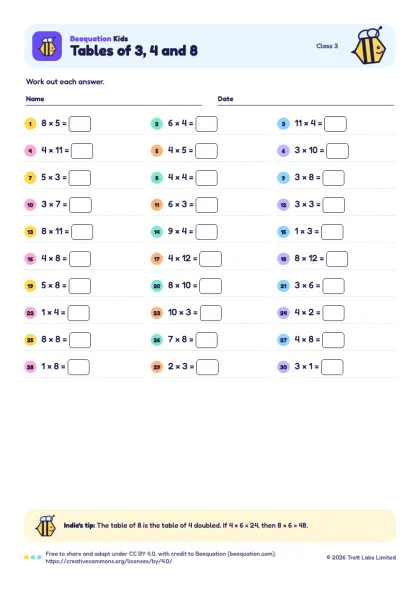 Tables of 3, 4 and 8Class 3 · Mixed questions from the tablesDownload PDF
Braille (BRF) (2 KB) · Braille text (4 KB)
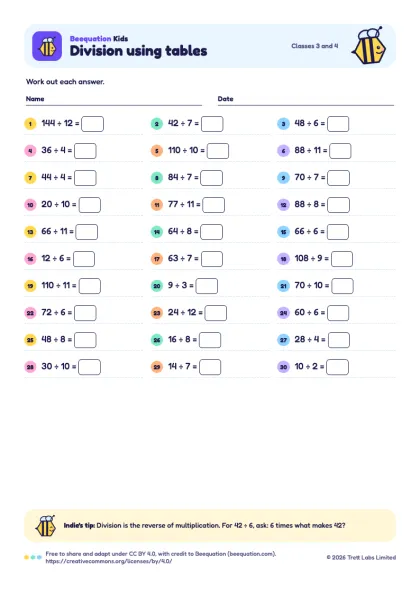 Division using tablesClass 3, Class 4 · Use the tables to divideDownload PDF
Braille (BRF) (2 KB) · Braille text (4 KB)
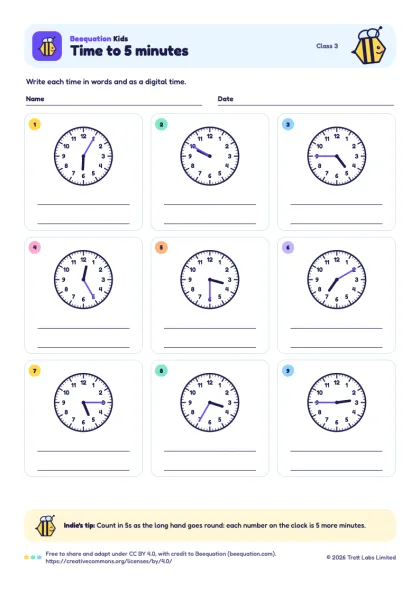 Time to 5 minutesClass 3 · Read the clocksDownload PDF
Braille (BRF) (2 KB) · Braille text (4 KB) · Tactile pictures (PDF) (94 KB)
Quick answers
No. The PARAKH Rashtriya Sarvekshan is a national survey for Classes 3, 6 and 9, and only some schools take part. It looks at how children across the country are learning; it is not an exam for your child, and there is nothing to prepare for.
No. Books and boards differ. Practise with the range in your child's own book, and make sure the idea of hundreds, tens and ones is secure before moving to thousands.
Practise with Indie
Beequation Kids turns number facts into honeycomb puzzles, with Indie giving a hint when a child is stuck. No ads and no data collected.
Previous: Class 2 maths · Next: Class 4 maths · How classroom methods work: how maths is taught.