 Beequation

Learn › Free primary maths worksheets
Choose a useful next step
Free primary maths worksheets
These free worksheets give parents and teachers a small, focused way to practise an idea. Choose by topic below, or use the class lists as a starting point. A class tag is a guide, not a statement that every Indian school teaches that skill in the same term.
Each worksheet comes as a printable PDF with its answers on a separate page. Large-print and easy-read versions sit alongside the standard one, and braille files are available too. For help choosing and using these formats, see our accessible maths and braille page. Preview the sheet before printing, especially if your child needs more writing space.
Choose by class
Match the sheet to the child's current schoolwork. Current NCERT books, state-board books and other school books do not always introduce a method or number range at the same point. If a skill is unfamiliar, teach it with objects or a drawing first.
Class 1
Start with counting, tens and ones, small addition and subtraction, shapes, money and familiar clock times. Use counters or sticks alongside the sheet when needed.
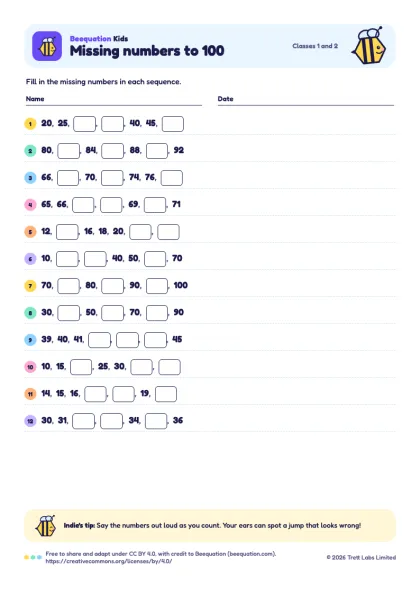 Missing numbers to 100Class 1, Class 2 · Count in 1s, 2s, 5s and 10sDownload PDF
Braille (BRF) (1 KB) · Braille text (3 KB)
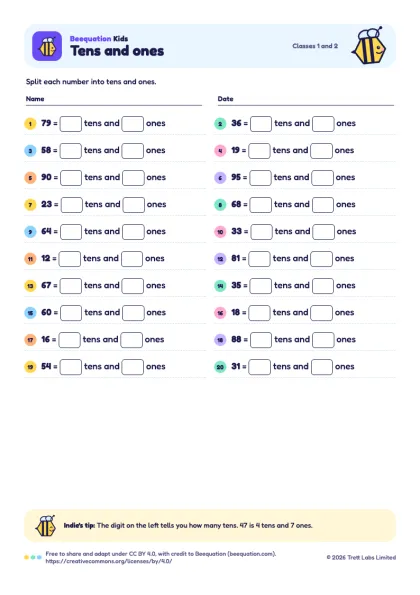 Tens and onesClass 1, Class 2 · Break two-digit numbers into tens and onesDownload PDF
Braille (BRF) (2 KB) · Braille text (4 KB)
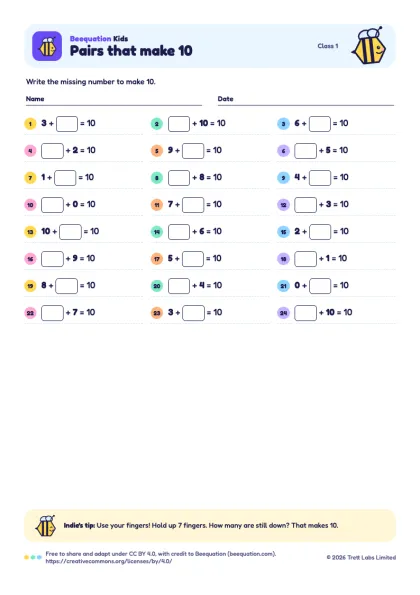 Pairs that make 10Class 1 · Number pairs that add up to 10Download PDF
Braille (BRF) (1 KB) · Braille text (3 KB)
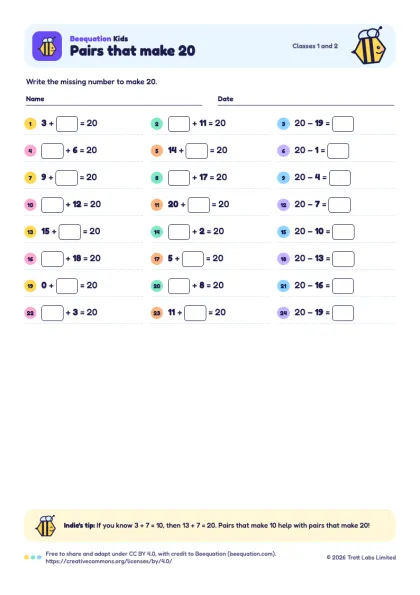 Pairs that make 20Class 1, Class 2 · Number pairs that add up to 20Download PDF
Braille (BRF) (1 KB) · Braille text (3 KB)
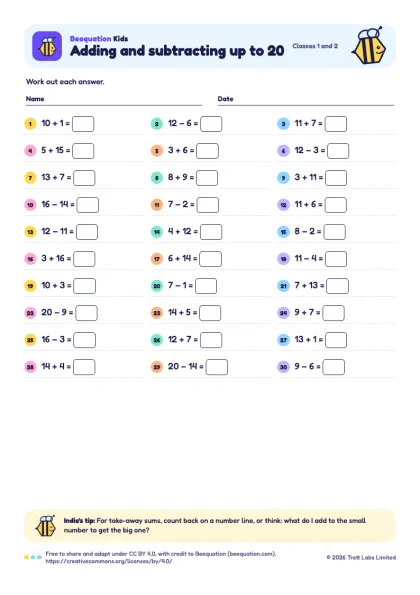 Adding and subtracting up to 20Class 1, Class 2 · Mixed sums up to 20Download PDF
Braille (BRF) (2 KB) · Braille text (4 KB)
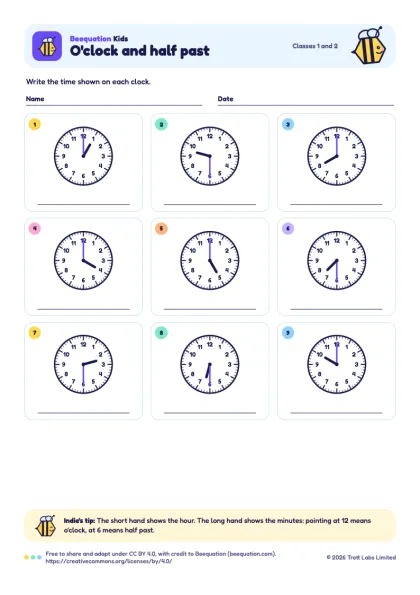 O'clock and half pastClass 1, Class 2 · Read the clocksDownload PDF
Braille (BRF) (1 KB) · Braille text (3 KB) · Tactile pictures (PDF) (95 KB)
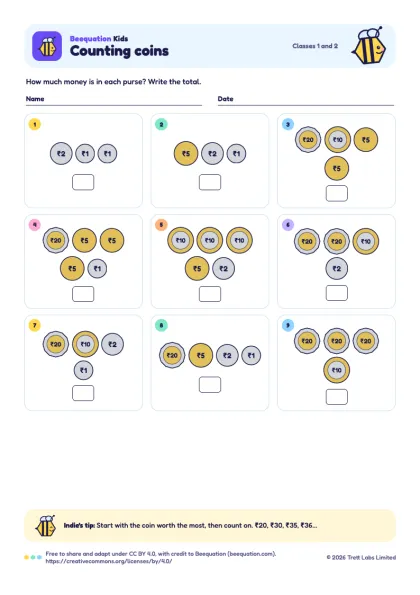 Counting coinsClass 1, Class 2 · Add up Indian coinsDownload PDF
Braille (BRF) (1 KB) · Braille text (3 KB) · Tactile pictures (PDF) (215 KB)
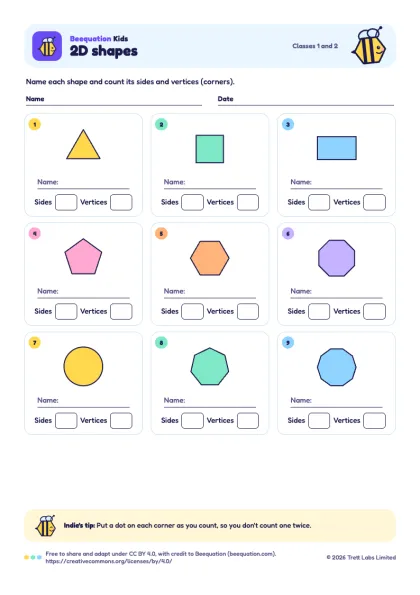 2D shapesClass 1, Class 2 · Names, sides and cornersDownload PDF
Braille (BRF) (2 KB) · Braille text (4 KB) · Tactile pictures (PDF) (77 KB)
Class 2
Choose work that builds on the child's secure number range. Use equal groups to explain early tables and a pretend shop to explain change.
Missing numbers to 100Class 1, Class 2 · Count in 1s, 2s, 5s and 10sDownload PDFBraille (BRF) (1 KB) · Braille text (3 KB)
Tens and onesClass 1, Class 2 · Break two-digit numbers into tens and onesDownload PDFBraille (BRF) (2 KB) · Braille text (4 KB)
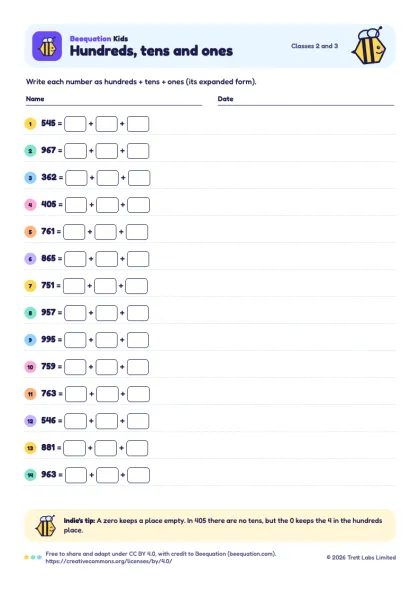 Hundreds, tens and onesClass 2, Class 3 · Place value up to 999Download PDF
Braille (BRF) (2 KB) · Braille text (3 KB)
Pairs that make 20Class 1, Class 2 · Number pairs that add up to 20Download PDFBraille (BRF) (1 KB) · Braille text (3 KB)
Adding and subtracting up to 20Class 1, Class 2 · Mixed sums up to 20Download PDFBraille (BRF) (2 KB) · Braille text (4 KB)
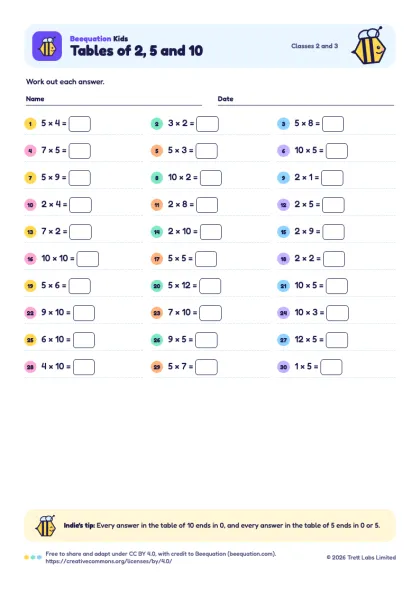 Tables of 2, 5 and 10Class 2, Class 3 · Mixed questions from the tablesDownload PDF
Braille (BRF) (2 KB) · Braille text (4 KB)
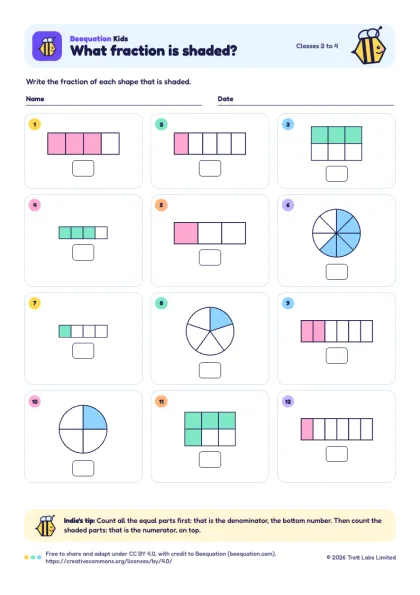 What fraction is shaded?Class 2, Class 3, Class 4 · Halves, thirds, quarters and moreDownload PDF
Braille (BRF) (1 KB) · Braille text (3 KB) · Tactile pictures (PDF) (675 KB)
O'clock and half pastClass 1, Class 2 · Read the clocksDownload PDFBraille (BRF) (1 KB) · Braille text (3 KB) · Tactile pictures (PDF) (95 KB)
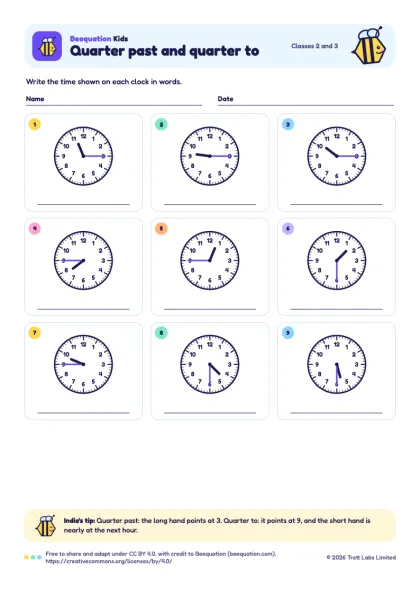 Quarter past and quarter toClass 2, Class 3 · Read the clocksDownload PDF
Braille (BRF) (2 KB) · Braille text (4 KB) · Tactile pictures (PDF) (95 KB)
Counting coinsClass 1, Class 2 · Add up Indian coinsDownload PDFBraille (BRF) (1 KB) · Braille text (3 KB) · Tactile pictures (PDF) (215 KB)
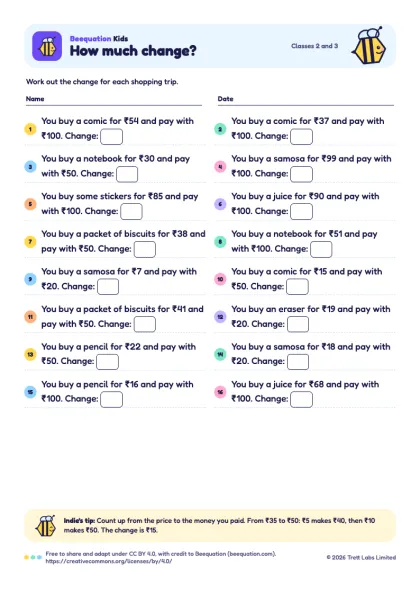 How much change?Class 2, Class 3 · Change from ₹20, ₹50 and ₹100Download PDF
Braille (BRF) (2 KB) · Braille text (5 KB)
2D shapesClass 1, Class 2 · Names, sides and cornersDownload PDFBraille (BRF) (2 KB) · Braille text (4 KB) · Tactile pictures (PDF) (77 KB)
Class 3
Connect written addition and subtraction to place value. Explain multiplication and division facts with groups and arrays; introduce clock intervals when they match the school's sequence.
Hundreds, tens and onesClass 2, Class 3 · Place value up to 999Download PDFBraille (BRF) (2 KB) · Braille text (3 KB)
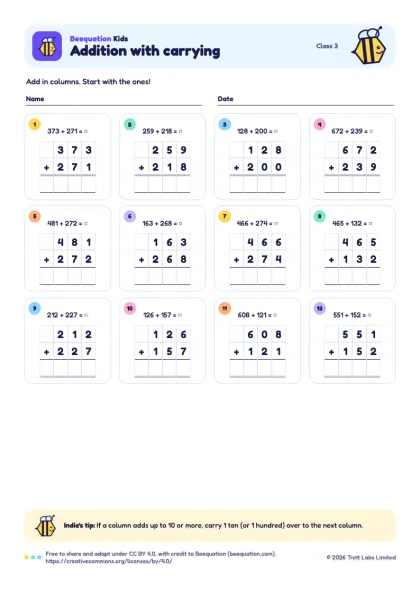 Addition with carryingClass 3 · Three-digit numbers in columns, with carryingDownload PDF
Braille (BRF) (1 KB) · Braille text (3 KB)
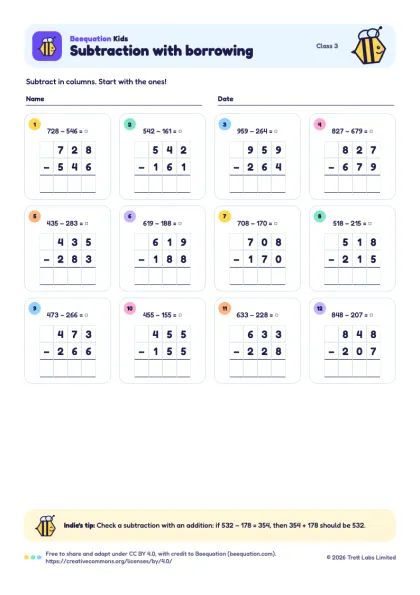 Subtraction with borrowingClass 3 · Three-digit numbers in columns, with borrowingDownload PDF
Braille (BRF) (1 KB) · Braille text (3 KB)
Tables of 2, 5 and 10Class 2, Class 3 · Mixed questions from the tablesDownload PDFBraille (BRF) (2 KB) · Braille text (4 KB)
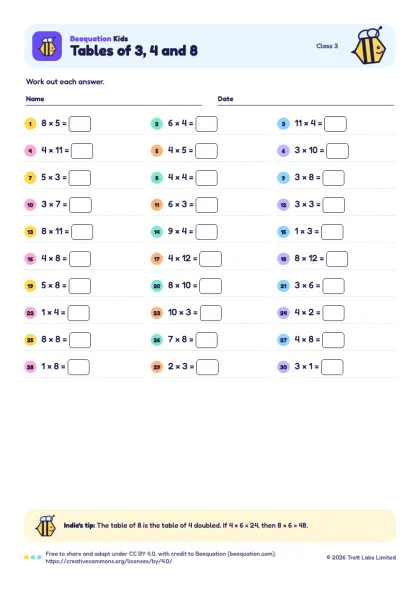 Tables of 3, 4 and 8Class 3 · Mixed questions from the tablesDownload PDF
Braille (BRF) (2 KB) · Braille text (4 KB)
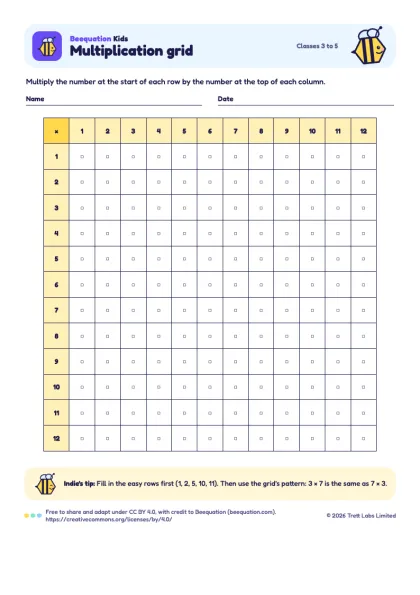 Multiplication gridClass 3, Class 4, Class 5 · Fill in the 12 12 gridDownload PDF
Braille (BRF) (5 KB) · Braille text (14 KB) · Tactile pictures (PDF) (114 KB)
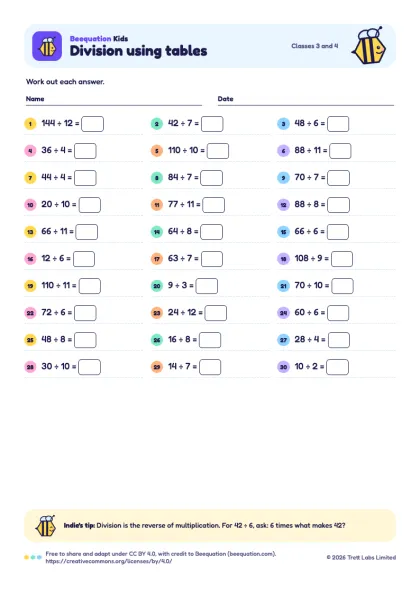 Division using tablesClass 3, Class 4 · Use the tables to divideDownload PDF
Braille (BRF) (2 KB) · Braille text (4 KB)
What fraction is shaded?Class 2, Class 3, Class 4 · Halves, thirds, quarters and moreDownload PDFBraille (BRF) (1 KB) · Braille text (3 KB) · Tactile pictures (PDF) (675 KB)
Quarter past and quarter toClass 2, Class 3 · Read the clocksDownload PDFBraille (BRF) (2 KB) · Braille text (4 KB) · Tactile pictures (PDF) (95 KB)
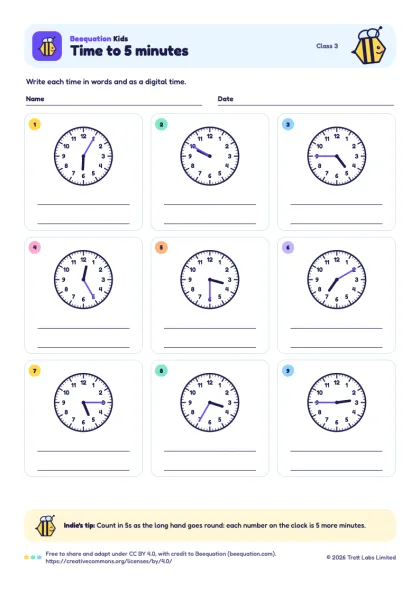 Time to 5 minutesClass 3 · Read the clocksDownload PDF
Braille (BRF) (2 KB) · Braille text (4 KB) · Tactile pictures (PDF) (94 KB)
How much change?Class 2, Class 3 · Change from ₹20, ₹50 and ₹100Download PDFBraille (BRF) (2 KB) · Braille text (5 KB)
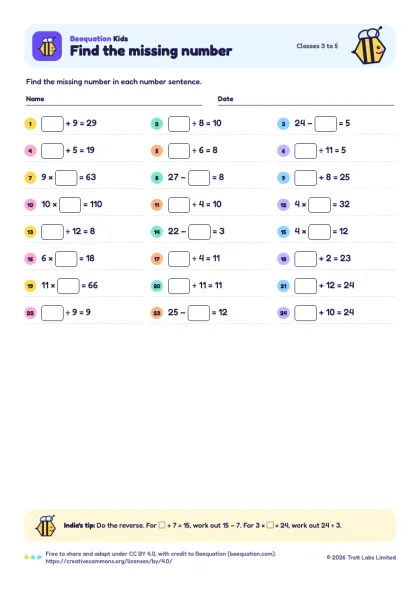 Find the missing numberClass 3, Class 4, Class 5 · Find the number in the boxDownload PDF
Braille (BRF) (1 KB) · Braille text (3 KB)
Class 4
Fractions, measures and written multiplication are useful choices when already introduced. Some tagged sheets, including decimal work, may be extensions in your school's programme.
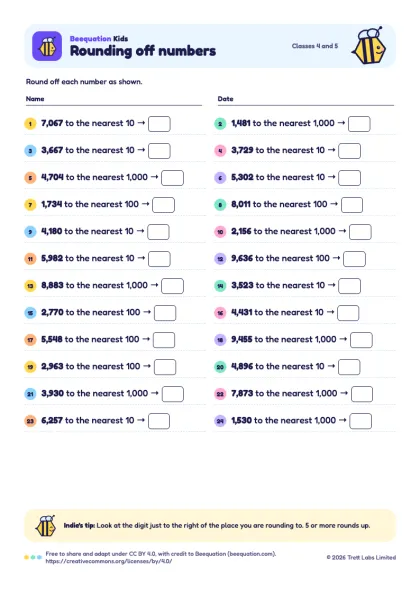 Rounding off numbersClass 4, Class 5 · Round off to the nearest 10, 100 and 1,000Download PDF
Braille (BRF) (2 KB) · Braille text (5 KB)
Multiplication gridClass 3, Class 4, Class 5 · Fill in the 12 12 gridDownload PDFBraille (BRF) (5 KB) · Braille text (14 KB) · Tactile pictures (PDF) (114 KB)
Division using tablesClass 3, Class 4 · Use the tables to divideDownload PDFBraille (BRF) (2 KB) · Braille text (4 KB)
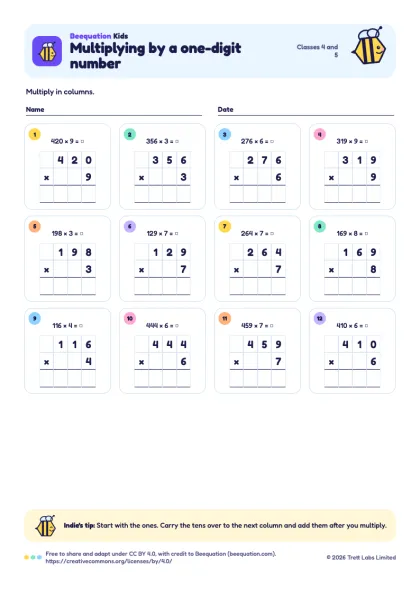 Multiplying by a one-digit numberClass 4, Class 5 · Three-digit numbers one-digit numbers, in columnsDownload PDF
Braille (BRF) (1 KB) · Braille text (3 KB)
What fraction is shaded?Class 2, Class 3, Class 4 · Halves, thirds, quarters and moreDownload PDFBraille (BRF) (1 KB) · Braille text (3 KB) · Tactile pictures (PDF) (675 KB)
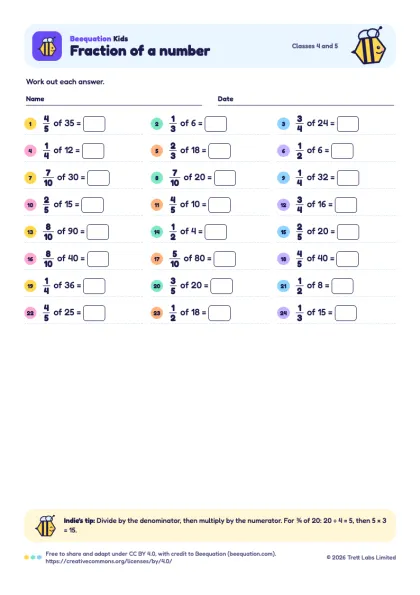 Fraction of a numberClass 4, Class 5 · Like of 12 and of 20Download PDF
Braille (BRF) (1 KB) · Braille text (3 KB)
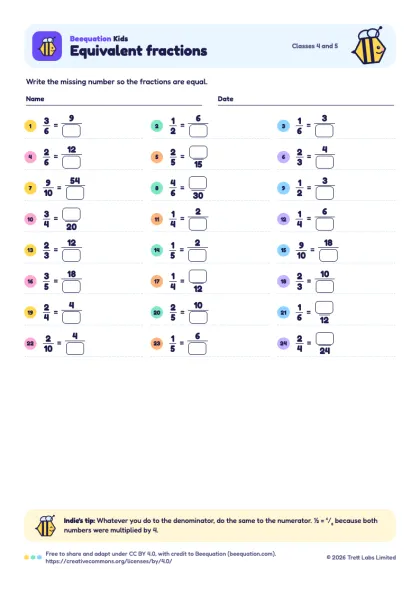 Equivalent fractionsClass 4, Class 5 · Find the missing numberDownload PDF
Braille (BRF) (2 KB) · Braille text (3 KB)
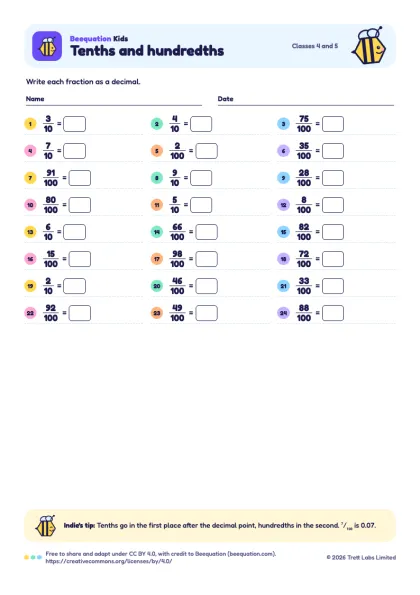 Tenths and hundredthsClass 4, Class 5 · Fractions as decimalsDownload PDF
Braille (BRF) (1 KB) · Braille text (3 KB)
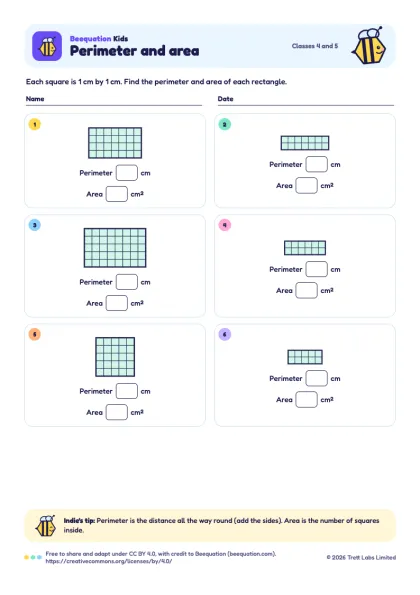 Perimeter and areaClass 4, Class 5 · Rectangles on a centimetre gridDownload PDF
Braille (BRF) (2 KB) · Braille text (4 KB) · Tactile pictures (PDF) (59 KB)
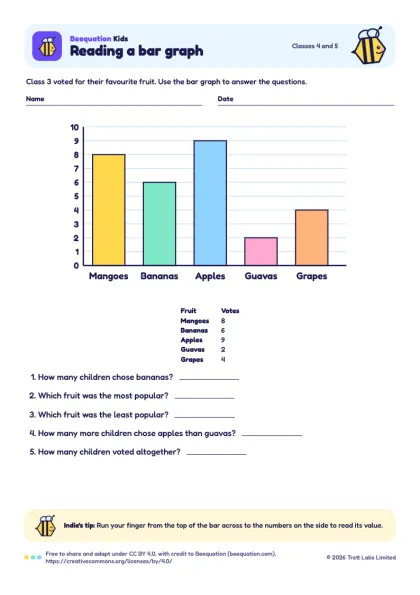 Reading a bar graphClass 4, Class 5 · Favourite fruit surveyDownload PDF
Braille (BRF) (1 KB) · Braille text (2 KB) · Tactile pictures (PDF) (41 KB)
Find the missing numberClass 3, Class 4, Class 5 · Find the number in the boxDownload PDFBraille (BRF) (1 KB) · Braille text (3 KB)
Class 5
Choose from fraction, calculation, measurement and data work. Decimal and percentage sheets are optional additional practice: check the school textbook rather than assuming they are required for every Class 5 child.
Rounding off numbersClass 4, Class 5 · Round off to the nearest 10, 100 and 1,000Download PDFBraille (BRF) (2 KB) · Braille text (5 KB)
Multiplication gridClass 3, Class 4, Class 5 · Fill in the 12 12 gridDownload PDFBraille (BRF) (5 KB) · Braille text (14 KB) · Tactile pictures (PDF) (114 KB)
Multiplying by a one-digit numberClass 4, Class 5 · Three-digit numbers one-digit numbers, in columnsDownload PDFBraille (BRF) (1 KB) · Braille text (3 KB)
Fraction of a numberClass 4, Class 5 · Like of 12 and of 20Download PDFBraille (BRF) (1 KB) · Braille text (3 KB)
Equivalent fractionsClass 4, Class 5 · Find the missing numberDownload PDFBraille (BRF) (2 KB) · Braille text (3 KB)
Tenths and hundredthsClass 4, Class 5 · Fractions as decimalsDownload PDFBraille (BRF) (1 KB) · Braille text (3 KB)
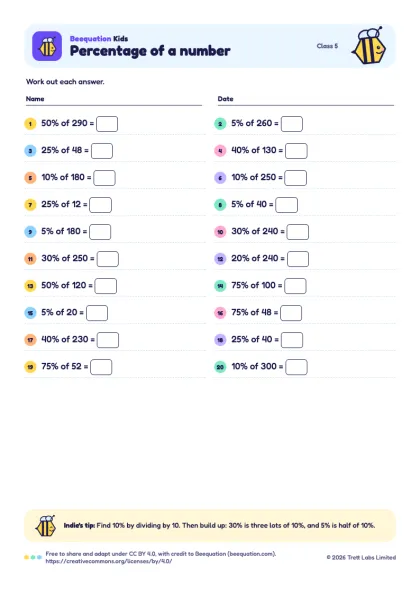 Percentage of a numberClass 5 · 10%, 25%, 50% and moreDownload PDF
Braille (BRF) (1 KB) · Braille text (3 KB)
Perimeter and areaClass 4, Class 5 · Rectangles on a centimetre gridDownload PDFBraille (BRF) (2 KB) · Braille text (4 KB) · Tactile pictures (PDF) (59 KB)
Reading a bar graphClass 4, Class 5 · Favourite fruit surveyDownload PDFBraille (BRF) (1 KB) · Braille text (2 KB) · Tactile pictures (PDF) (41 KB)
Find the missing numberClass 3, Class 4, Class 5 · Find the number in the boxDownload PDFBraille (BRF) (1 KB) · Braille text (3 KB)
Choose by topic
Counting and place value
Missing numbers, tens and ones, hundreds and rounding. Ask what each digit represents before asking for a rule. Read the place-value guide if carrying and borrowing need a fresh explanation.
Missing numbers to 100Class 1, Class 2 · Count in 1s, 2s, 5s and 10sDownload PDFBraille (BRF) (1 KB) · Braille text (3 KB)
Tens and onesClass 1, Class 2 · Break two-digit numbers into tens and onesDownload PDFBraille (BRF) (2 KB) · Braille text (4 KB)
Hundreds, tens and onesClass 2, Class 3 · Place value up to 999Download PDFBraille (BRF) (2 KB) · Braille text (3 KB)
Rounding off numbersClass 4, Class 5 · Round off to the nearest 10, 100 and 1,000Download PDFBraille (BRF) (2 KB) · Braille text (5 KB)
Addition and subtraction
Number bonds, calculations within 20 and column methods. A child who finds a column sheet difficult may need more practice with carrying and borrowing using bundles and sticks, rather than a longer sheet.
Pairs that make 10Class 1 · Number pairs that add up to 10Download PDFBraille (BRF) (1 KB) · Braille text (3 KB)
Pairs that make 20Class 1, Class 2 · Number pairs that add up to 20Download PDFBraille (BRF) (1 KB) · Braille text (3 KB)
Adding and subtracting up to 20Class 1, Class 2 · Mixed sums up to 20Download PDFBraille (BRF) (2 KB) · Braille text (4 KB)
Addition with carryingClass 3 · Three-digit numbers in columns, with carryingDownload PDFBraille (BRF) (1 KB) · Braille text (3 KB)
Subtraction with borrowingClass 3 · Three-digit numbers in columns, with borrowingDownload PDFBraille (BRF) (1 KB) · Braille text (3 KB)
Multiplication and division
Early tables, multiplication grids, division facts and short multiplication. Use our tables practice guide to connect a remembered fact to its meaning.
Tables of 2, 5 and 10Class 2, Class 3 · Mixed questions from the tablesDownload PDFBraille (BRF) (2 KB) · Braille text (4 KB)
Tables of 3, 4 and 8Class 3 · Mixed questions from the tablesDownload PDFBraille (BRF) (2 KB) · Braille text (4 KB)
Multiplication gridClass 3, Class 4, Class 5 · Fill in the 12 12 gridDownload PDFBraille (BRF) (5 KB) · Braille text (14 KB) · Tactile pictures (PDF) (114 KB)
Division using tablesClass 3, Class 4 · Use the tables to divideDownload PDFBraille (BRF) (2 KB) · Braille text (4 KB)
Multiplying by a one-digit numberClass 4, Class 5 · Three-digit numbers one-digit numbers, in columnsDownload PDFBraille (BRF) (1 KB) · Braille text (3 KB)
Fractions
Shaded fractions, fractions of amounts and equivalent fractions. Make sure the whole is clear and its parts are equal before comparing answers.
What fraction is shaded?Class 2, Class 3, Class 4 · Halves, thirds, quarters and moreDownload PDFBraille (BRF) (1 KB) · Braille text (3 KB) · Tactile pictures (PDF) (675 KB)
Fraction of a numberClass 4, Class 5 · Like of 12 and of 20Download PDFBraille (BRF) (1 KB) · Braille text (3 KB)
Equivalent fractionsClass 4, Class 5 · Find the missing numberDownload PDFBraille (BRF) (2 KB) · Braille text (3 KB)
Decimals and percentages: additional practice
Use tenths, hundredths and percentages only after the school has introduced them, or as an agreed extension. These sheets are not a national primary syllabus checklist.
Tenths and hundredthsClass 4, Class 5 · Fractions as decimalsDownload PDFBraille (BRF) (1 KB) · Braille text (3 KB)
Percentage of a numberClass 5 · 10%, 25%, 50% and moreDownload PDFBraille (BRF) (1 KB) · Braille text (3 KB)
Telling the time
Clock times from o'clock and half past to quarter hours and five-minute intervals. Let children move the hands on a teaching clock before writing the time.
O'clock and half pastClass 1, Class 2 · Read the clocksDownload PDFBraille (BRF) (1 KB) · Braille text (3 KB) · Tactile pictures (PDF) (95 KB)
Quarter past and quarter toClass 2, Class 3 · Read the clocksDownload PDFBraille (BRF) (2 KB) · Braille text (4 KB) · Tactile pictures (PDF) (95 KB)
Time to 5 minutesClass 3 · Read the clocksDownload PDFBraille (BRF) (2 KB) · Braille text (4 KB) · Tactile pictures (PDF) (94 KB)
Money
Counting coins and finding change in whole rupees. Keep the total spent and the amount paid visible, then check that cost plus change equals the payment.
Counting coinsClass 1, Class 2 · Add up Indian coinsDownload PDFBraille (BRF) (1 KB) · Braille text (3 KB) · Tactile pictures (PDF) (215 KB)
How much change?Class 2, Class 3 · Change from ₹20, ₹50 and ₹100Download PDFBraille (BRF) (2 KB) · Braille text (5 KB)
Measurement
Perimeter and area practice. Trace the boundary for perimeter and cover the surface with squares for area; the two answers use different kinds of units.
Perimeter and areaClass 4, Class 5 · Rectangles on a centimetre gridDownload PDFBraille (BRF) (2 KB) · Braille text (4 KB) · Tactile pictures (PDF) (59 KB)
Shapes and geometry
Identify and describe 2D shapes. Ask about sides and corners, not only whether a shape looks like the example on a classroom chart.
2D shapesClass 1, Class 2 · Names, sides and cornersDownload PDFBraille (BRF) (2 KB) · Braille text (4 KB) · Tactile pictures (PDF) (77 KB)
Data handling
Read bar graphs using their labels and scales. Where a bar graph sheet is ahead of the child's schoolwork, begin with sorting objects or a pictograph instead.
Reading a bar graphClass 4, Class 5 · Favourite fruit surveyDownload PDFBraille (BRF) (1 KB) · Braille text (2 KB) · Tactile pictures (PDF) (41 KB)
Patterns and algebra: fill in the blanks
These sheets belong to our patterns and algebra page, but the activity is finding a missing number in a box, such as □ + 7 = 15 (the answer is 8). No letters or formal algebra are needed.
Find the missing numberClass 3, Class 4, Class 5 · Find the number in the boxDownload PDFBraille (BRF) (1 KB) · Braille text (3 KB)
Use a sheet without turning it into a test
Try one example together. Let the child explain a second example, then decide whether independent practice will help. There is no need to finish every question in one sitting or add a timer. For a class with different starting points, choose a smaller number range or offer counters while keeping the same mathematical idea.
Check a few answers together and discuss one mistake calmly. For 46 + 19, a child might use 46 + 20 1 = 65. Checking 65 19 = 46 confirms the sum; copying “65” from an answer sheet does not tell you whether the method is understood.
Teachers can also use the free 24-puzzle classroom pack, maths starters and differentiation ideas. Our worksheet downloads are shared under CC BY 4.0: keep the Beequation credit when copying or adapting them. That permission applies to the worksheet material, not to Beequation's brand or game software.
Practise with Indie
Beequation Kids turns number facts into honeycomb puzzles, with Indie giving a hint when a child is stuck. No ads and no data collected.