 Beequation

Learn › Maths help by class › Class 4 maths
Connect methods with meaning
Class 4 maths
Class 4 maths asks children to connect skills: reading a word problem, choosing an operation, carrying out a calculation and checking what the answer means. Children are usually about 9 to 10. They still benefit from a picture or practical model when an idea is new.
The NCERT book for Class 4 is Maths Mela, which works with numbers in the thousands and the Indian number system. Many private-publisher books go on to five-digit numbers (up to 99,999) and add topics such as factors, Roman numerals or decimals this year. Match practice to your child's textbook and the teacher's method; a longer list of topics is not automatically a better guide.
Read larger numbers and estimate
Break 4,706 into 4,000 + 700 + 6. The zero shows there are no tens. Compare it with 4,760 by looking at each place from left to right. The thousands and hundreds match; six tens make 4,760 larger than 4,706. Our counting and place value page shows the Indian place value chart.
Rounding off helps with estimates when it is part of the school lesson. For example, 2,348 is about 2,300 to the nearest hundred, and 1,627 is about 1,600. Their sum should be around 3,900. The exact answer is 3,975, which fits that estimate. An estimate is a check, not a replacement for the exact answer when one is asked for.
Carrying and borrowing with bigger numbers
Four-digit addition and subtraction use the same place-value thinking as smaller sums. Line up the columns, including zeros. A carried 1 in the tens column stands for one ten; a hundred borrowed and opened up becomes ten tens. Your child's book may call both of these regrouping.
For 4,032 1,785, borrow carefully across the zero. The answer is 2,247. Check by adding: 1,785 + 2,247 = 4,032. If the written steps are confusing, show the thousands, hundreds, tens and ones on a place value chart before doing the sum again. See addition and subtraction for more.
Multiply by a two-digit number
Split the multiplier into tens and ones so each part has meaning. A grid, an expanded calculation and the column method can all show the same multiplication. Follow the school's layout for work in the copy.
Worked example: 234 23
Twenty-three is twenty plus three. First work out 234 3 = 702. Then work out 234 20 = 4,680. Add the two products: 702 + 4,680 = 5,382. Check the size: 234 20 is already 4,680, so the total must be larger than that.
Many teachers ask children to write a 0 (some use a cross) in the ones place of the second row before multiplying by the tens digit. Help your child see why: that row is 234 20, not 234 2, so it must be worth ten times as much.
Divide in manageable parts
The NCERT Class 4 book teaches division by taking away useful multiples of the divisor, called partial quotients, written in the bracket layout with the divisor on the left and the quotient on the right. Other books go straight to the standard long division layout. Whichever layout your child uses, they should be able to explain the groups being taken away. More on this in multiplication and division.
Worked example: 857 4
Four groups of 200 use 800, leaving 57. Four groups of 10 use 40, leaving 17. Four groups of 4 use 16, leaving 1. Add the parts of the quotient: 200 + 10 + 4 = 214. So 857 4 gives quotient 214 and remainder 1.
Check with dividend = divisor quotient + remainder: 4 214 + 1 = 856 + 1 = 857. The remainder is smaller than 4, so another whole group cannot be made. Some books bring in two-digit divisors this year; others wait for Class 5.
Read the question again after calculating. Three buses with 24 children each asks for a total; 72 children shared among three buses asks for a share. The numbers alone don't tell you which operation to use.
Multiples and equivalent fractions
A multiple comes from a table: the first multiples of 6 are 6, 12, 18, 24 and 30. The NCERT Class 4 book introduces multiples, and factors follow in Class 5 (many private books teach both this year). Explore divisibility by 2, 5 and 10 using the last digit.
Fractions are easier to compare when the whole stays the same. Shade half of a paper strip, then divide a strip of the same size into four equal parts and shade two. Both show the same amount: = . See fractions for pictures.
In the same way, = : draw thirds and split each third in two. For a collection, one-fourth of 20 is 5, because 20 4 = 5. Many private books also add and subtract fractions with the same denominator this year. Use a picture: + = . The pieces are still sevenths; only their number changes.
Measurement, perimeter and area
Use unit relationships in practical problems: 100 cm = 1 m, 1,000 g = 1 kg and 1,000 mL = 1 L. A length of 2 m 35 cm is 235 cm. Check that the answer uses the unit the question asks for. Our measurement page has more.
Perimeter is the distance around a boundary. A rectangle 8 cm long and 5 cm wide has perimeter 8 + 5 + 8 + 5 = 26 cm. Area is the surface covered. On centimetre squared paper, the same rectangle covers 8 5 = 40 square centimetres. Counting the squares shows why these are different measurements.
Use bills and rates too. Three kilograms of rice at ₹40 per kg cost 3 ₹40 = ₹120. Whole-rupee prices keep the rate problem clear. Many private books also start decimals this year, through rupees and paise and through metres and centimetres; the NCERT books for Classes 1 to 5 don't teach decimals.
Time, shapes and pictographs
Connect am and pm with the day, and read the 24-hour clock used on railway tickets and timetables; the NCERT Class 4 book introduces it. 14:30 is 2:30 pm. From 14:30 to 15:10 is forty minutes: thirty minutes to 15:00 and ten more to 15:10.
Explore right, acute and obtuse angles through corners and turns. A radius joins a circle's centre to its edge; a diameter goes through the centre from one side to the other. Draw circles with a compass when that is part of the lesson. Fold shapes, try nets of a cube and read simple maps. Naming an angle doesn't mean measuring it in degrees yet.
Read pictographs by using the key. If each flower picture stands for four plants, three pictures stand for twelve plants. Ask which category has most, how two categories compare and how the key changes the count.
By the end of Class 4, many children can…
- read, write and compare numbers in the thousands, and up to 99,999 if their book goes that far;
- add and subtract four-digit numbers and check by the inverse operation;
- multiply by a two-digit number and divide by a one-digit number, explaining the steps;
- list multiples of a number and find equivalent fractions with a picture;
- find the perimeter of a shape and the area of a rectangle by counting squares;
- change between 12-hour and 24-hour times.
Children reach these at different times. A secure understanding of the earlier steps is worth more than rushing ahead.
Words your child will hear
Thousands, ten thousands; round off, estimate; multiplicand, multiplier, product; dividend, divisor, quotient, remainder; multiple; equivalent fractions; perimeter, area, square centimetre; am, pm, 24-hour clock; centre, radius, diameter; right angle; pictograph, key. In Hindi: गुणज (multiple), परिमाप (perimeter), क्षेत्रफल (area).
Indie the honeybee checks her work with an estimate and another operation. Encourage your child to explain one useful check, rather than doing every question twice without a purpose.
Indie's challengeIndie sees 3 rows of flowers with 24 flowers in each row. How many flowers are there? Show the answer
3 24 = 72. Three groups of twenty give sixty and three groups of four give twelve. 60 + 12 = 72. Check: 72 3 = 24.
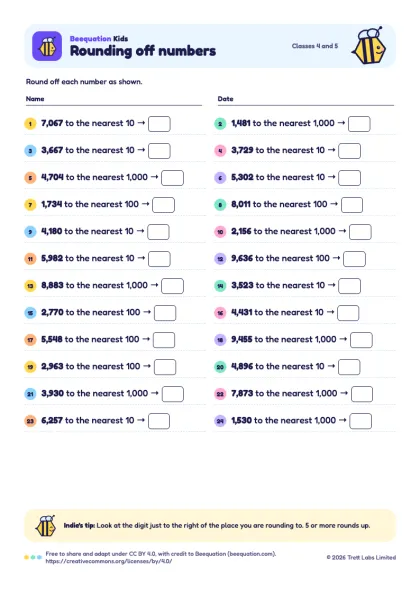 Rounding off numbersClass 4, Class 5 · Round off to the nearest 10, 100 and 1,000Download PDF
Braille (BRF) (2 KB) · Braille text (5 KB)
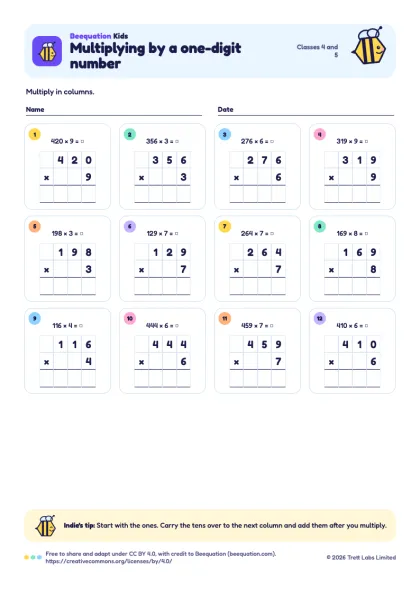 Multiplying by a one-digit numberClass 4, Class 5 · Three-digit numbers one-digit numbers, in columnsDownload PDF
Braille (BRF) (1 KB) · Braille text (3 KB)
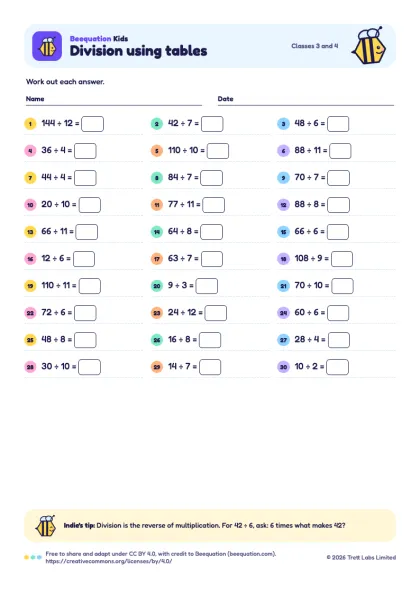 Division using tablesClass 3, Class 4 · Use the tables to divideDownload PDF
Braille (BRF) (2 KB) · Braille text (4 KB)
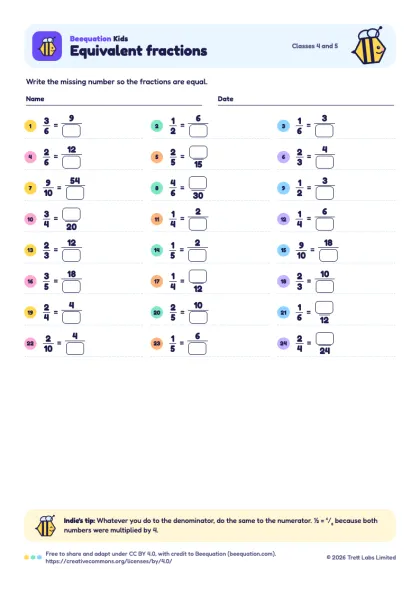 Equivalent fractionsClass 4, Class 5 · Find the missing numberDownload PDF
Braille (BRF) (2 KB) · Braille text (3 KB)
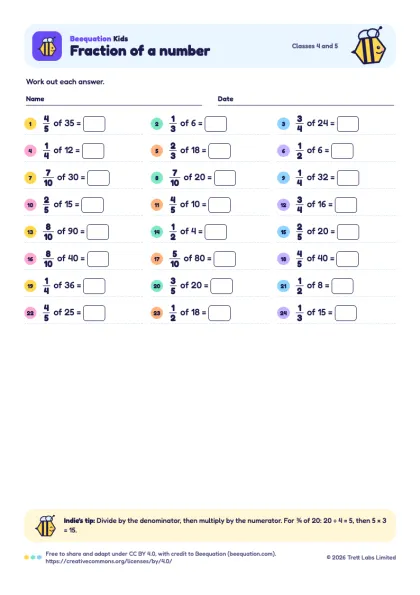 Fraction of a numberClass 4, Class 5 · Like of 12 and of 20Download PDF
Braille (BRF) (1 KB) · Braille text (3 KB)
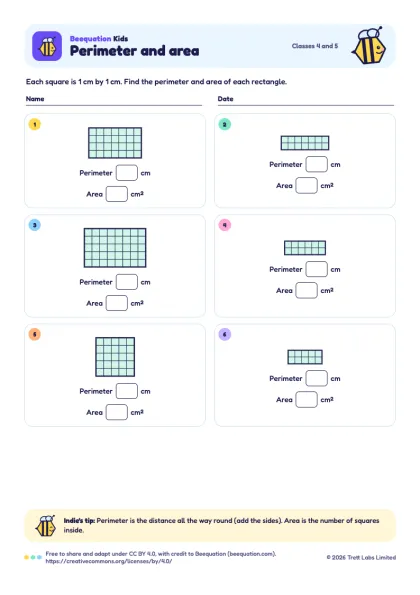 Perimeter and areaClass 4, Class 5 · Rectangles on a centimetre gridDownload PDF
Braille (BRF) (2 KB) · Braille text (4 KB) · Tactile pictures (PDF) (59 KB)
Quick answers
Many schools and families practise tables up to 20 in Classes 4 and 5. They help, but quick recall of the tables up to 10, and knowing how to work out a forgotten fact, matter more.
The NCERT books build long division from partial quotients: taking away 200 fours, then 10 fours, and so on. It shows why the standard method works. A school may introduce a shorter layout later.
Practise with Indie
Beequation Kids turns number facts into honeycomb puzzles, with Indie giving a hint when a child is stuck. No ads and no data collected.
Previous: Class 3 maths · Next: Class 5 maths · Classroom methods: how maths is taught.