 Beequation

Learn › Maths topics for Classes 1 to 5 › Mental maths
Maths topics · Classes 1 to 5
Mental maths
Mental maths (some schools say “oral maths”) means working with numbers using facts and relationships you understand. It does not mean keeping every step hidden in your head or answering before anyone else. Children can talk, sketch or jot down a number while developing a strategy.
For parents, a few thoughtful questions during daily life can be useful practice. For teachers, hearing two methods for the same calculation reveals more than a list of quick answers. Ask, “What did you notice?” and “Why does that work?”
Build on what each class is learning
- Class 1: count on and count back, compare small amounts and explore pairs that make 10 with objects.
- Class 2: add tens, use doubles and familiar addition and subtraction facts.
- Class 3: tables, 10 and 100, and division facts. The NIPUN Bharat goals for the end of Class 3 include the tables of 2 to 10.
- Class 4: estimating and rounding off, and choosing methods for larger numbers.
- Class 5: combine strategies, estimate and check answers in practical problems.
Follow your child's book and current lessons. Many schools and families go on to tables up to 20 in Classes 4 and 5; that is useful, but understanding the tables up to 10 comes first.
Use pairs that make 10
Pairs that make 10 (some books say addition facts or number pairs) are the starting point for a lot of mental maths. Knowing that 8 needs 2 to make 10 helps with 8 + 5. Split 5 into 2 and 3:
8 + 5 = 8 + 2 + 3 = 10 + 3 = 13.
Use ten counters or a ten-frame to show the two spaces beside eight. Move two of the five counters into those spaces and leave three outside. The total remains thirteen.
Practise the pairs in both orders: 6 + 4 and 4 + 6 both make 10. Then connect them with subtraction: 10 6 = 4 and 10 4 = 6. The facts form a connected family, not four unrelated answers.
Use doubles and near doubles
A double adds the same amount twice. If your child knows 6 + 6 = 12, then 6 + 7 is one more: 13. If they know 7 + 7 = 14, then 6 + 7 is one less: also 13.
Both routes are valid. Ask which double was more familiar. Draw two rows of counters so the extra counter is visible.
Halving connects with doubling. If double 8 is 16, half of 16 is 8. Begin with collections that can be shared into two equal whole-number groups before introducing fractional answers.
Partition numbers into useful parts
Partitioning means breaking a number into parts without changing its value. For 47 + 38, one method is to add the tens and then the ones:
47 + 30 = 77, then 77 + 8 = 85.
Another method makes the next ten. Split 38 into 3 and 35: 47 + 3 = 50, then 50 + 35 = 85. In both methods, all 38 has been added.
Encourage your child to check that no part has been lost or added twice. Saying “I split 38 into 3 and 35” makes the reasoning clear.
Friendly numbers such as 50 or 100 make sums quicker, but ask your child to say the adjustment aloud (“I added one too many, so I take one away”) and check that the new sum still matches the original question.
Round and compensate
Some numbers are close to a convenient ten or hundred. To calculate 49 + 26, add 50 instead of 49: 50 + 26 = 76. That is one too many, so subtract 1. The answer is 75.
For 99 7, use 100 7 = 700. This includes one extra group of 7, so remove 7: 700 7 = 693.
Do not round and leave the answer unchanged. Rounding gives an estimate; compensation brings us back to the exact calculation. Ask, “What extra amount did we include?”
Connect multiplication facts
If 4 6 = 24, doubling the number of groups gives 8 6 = 48. If 10 8 = 80, half as many groups gives 5 8 = 40.
To calculate 16 5, find 16 10 = 160, then halve it: 80. This works because five groups is half as many as ten groups of the same size.
Some combinations become useful landmarks. Four groups of 25 make 100, so 25 4 = 100. Show four equal piles or quarters of a hundred-square before expecting the fact to be recalled.
Link division to those facts: if 6 4 = 24, then 24 6 = 4 and 24 4 = 6. See the multiplication and division page for equal-group models.
Estimate before checking
For 198 + 304, an estimate is 200 + 300 = 500. The exact answer is 502. The estimate does not replace the answer, but it helps us notice if we have written 52 or 5,020.
Choose an estimate that suits the question. If buying items, decide whether an approximate total is enough to check a budget or whether an exact amount is needed to pay. All classroom shopping prices can be fictional.
Vedic maths and abacus classes
Many children enjoy Vedic maths tricks, such as squaring a number that ends in 5 (35 35: 3 4 = 12, then write 25, so 1,225) or multiplying a two-digit number by 11 (23 11: write 2, then 2 + 3 = 5, then 3, giving 253). They work because of place value, and they are most useful once children understand why.
Abacus classes are also popular after school. Some children love them and get quick at sums. Both are optional extras: neither is needed for school maths, and neither replaces understanding place value, fractions or word problems.
Common difficulties
- Counting everything from one: show how a known total lets the child count on.
- Choosing a rule without understanding: return to objects or a drawing that explains the relationship.
- Losing an adjustment: say the extra or missing amount aloud.
- Freezing under time pressure: remove the timer and allow thinking, talking and jotting.
- Using the same method for every number: compare methods and ask which feels manageable.
Five-minute games for home
- Roll two dice from a ludo set and explain two ways to find the total.
- Clap equal groups and connect the pattern with a multiplication fact.
- Play bingo with pairs that make 10 or 20.
- Ask students to sort calculations by the strategy they would choose.
- Give one calculation at the board and invite different explanations, not a race.
Indie's challengeIndie wants to find 49 6 without a written multiplication method. How could she use 50 6? Show the answer
50 6 = 300. That includes one extra group of 6, so subtract 6: 300 6 = 294. Therefore 49 6 = 294.
Free mental maths worksheets
Use these as conversation starters. Ask for an explanation of one or two answers rather than timing the whole sheet.
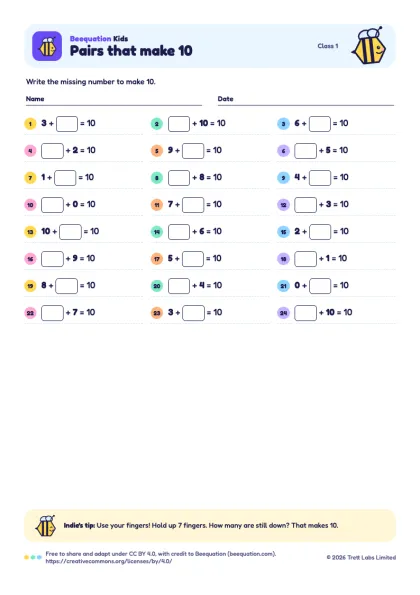 Pairs that make 10Class 1 · Number pairs that add up to 10Download PDF
Braille (BRF) (1 KB) · Braille text (3 KB)
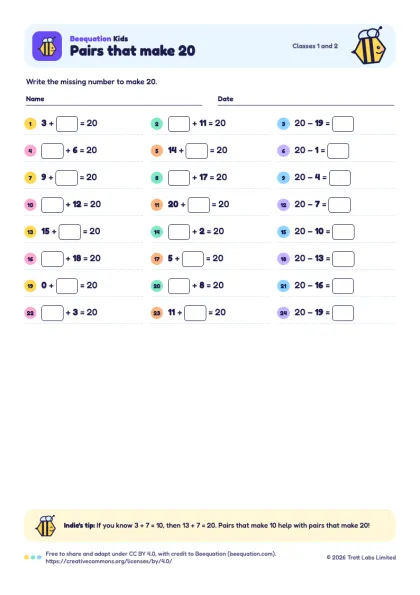 Pairs that make 20Class 1, Class 2 · Number pairs that add up to 20Download PDF
Braille (BRF) (1 KB) · Braille text (3 KB)
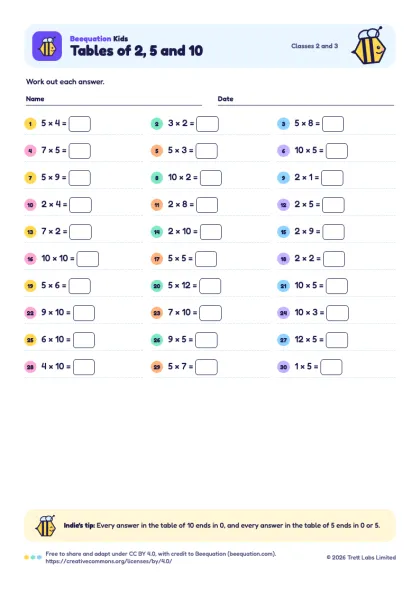 Tables of 2, 5 and 10Class 2, Class 3 · Mixed questions from the tablesDownload PDF
Braille (BRF) (2 KB) · Braille text (4 KB)
Questions parents and teachers ask
No. A sketch or a short note can support thinking. The focus is choosing and understanding number relationships rather than automatically using a written algorithm.
If the child's method is accurate and they can explain it, compare it with yours. Different numbers may make different methods useful.
You can build and check understanding without a timer. When a child needs longer, ask about their method and provide practice with the facts that support it.
Practise with Indie
Beequation Kids turns number facts into honeycomb puzzles, with Indie giving a hint when a child is stuck. No ads and no data collected.