 Beequation

Learn › Maths topics for Classes 1 to 5 › Patterns and algebra
Maths topics · Classes 1 to 5
Patterns and algebra
Algebra begins well before children meet letters in an equation. A repeating border, a missing number and a question about two equal amounts all ask children to notice relationships. The aim in primary school is to explain what stays the same, what changes and why an answer works.
Indian books call this topic patterns, and many books love number puzzles and magic squares. For Classes 1 to 5, start with objects, pictures and familiar arithmetic. Unknowns are shown as a box □ or a blank (“Fill in the blanks”), not letters; letters for unknowns and ratio usually begin in Class 6.
How these ideas develop
- Class 1: copy, continue and make repeating patterns with colours, shapes, sounds or movements.
- Class 2: number and shape patterns, and growing patterns.
- Class 3: patterns in the tables and missing numbers in a box (□).
- Class 4: rules for number patterns and patterns in multiplication.
- Class 5: number sequences, square and triangular numbers, magic squares and □ in number sentences.
This is a guide to the ideas, not a fixed chapter order or a separate algebra syllabus.
Find the repeating unit
In a pattern of red, blue, blue, red, blue, blue, the repeating unit is red, blue, blue. A child who says “red and blue” has named the colours but not yet described the whole unit.
Use counters or draw circles rather than relying on colour alone. A triangle, circle, circle pattern has the same structure. Clap, tap, tap can represent it with sounds.
Ask your child to point to one complete unit, then another. Cover a position in the middle and ask what must go there. Finding a missing part is a stronger check of understanding than adding one more object at the end.
Ask “Which part repeats?” before “What comes next?” It encourages your child to describe a rule rather than guess from the last item they can see.
Growing number patterns
Look at 2, 5, 8, 11. Each step adds 3, so the next two numbers are 14 and 17. Say the rule in words and check it between every neighbouring pair.
For 30, 25, 20, 15, subtract 5 each time. The next number is 10. A descending pattern is not an error; it follows a different rule.
Do not assume every pattern uses the same-sized step. With objects, children might build rows of 1, 3, 5 and 7 counters. Each new row has two more counters than the previous row. Drawing the arrangement can show the growth more clearly than looking only at the written numbers.
A short list can fit more than one possible rule. When the intended rule is not given, accept a child's explanation if it consistently fits the terms shown. Ask them to continue further and demonstrate the rule rather than insisting that their first guess matches yours.
The equals sign means “the same value as”
Children often meet sums written as 8 + 5 = 13 and begin to read the equals sign as “write the answer now”. It actually says that the expressions on both sides have the same value.
8 + 5 = 10 + 3 is true because both sides equal 13. So is 13 = 8 + 5. A balance or two groups of counters can make this meaning visible.
Try 6 + 4 = □ + 3. The left side is 10. The missing number is 7, because 7 + 3 is also 10. Writing 10 in the box would make the right side 13, so it would no longer be an equality.
Read the complete statement aloud after filling the box. This small habit prevents a child from solving only the calculation nearest the blank.
Missing numbers and inverse operations
For □ + 7 = 15, ask, “What number joins with 7 to make 15?” Counting on gives 8; subtraction checks it: 15 7 = 8. Substitute the answer: 8 + 7 = 15.
For □ 3 = 24, divide 24 into three equal groups. Each group has 8, so the box holds 8. Check: 8 3 = 24.
The blank can appear in different positions. In 18 □ = 11, the missing number is 7. In □ 7 = 11, it is 18. The same visible numbers do not make these the same problem.
Let your child use counters, an array or a number line before expecting an entirely mental answer. An explanation of the relationship matters more than a rule such as “move it to the other side”.
A number puzzle with several conditions
A magic square asks for the same total along each row, each column and both diagonals. In this example, every total is 15:
| A 3 by 3 magic square | ||
|---|---|---|
| 2 | 7 | 6 |
| 9 | 5 | 1 |
| 4 | 3 | 8 |
Check a row: 2 + 7 + 6 = 15. Check a column: 7 + 5 + 3 = 15. Then check the diagonals: 2 + 5 + 8 = 15 and 6 + 5 + 4 = 15.
Cover one number and ask your child to recover it using a row or column. Afterwards, check all the conditions, not only the line used to find the answer. This is useful practice in explaining and verifying a solution.
Scaling a familiar amount
Suppose a fictional recipe uses 2 cups of rice for 4 people. Keeping the same amount per person, cooking for 8 people needs twice as much rice: 4 cups. Both the number of people and the rice amount have doubled.
This is an informal multiplication problem. There is no need to introduce colon notation or formal ratio calculations to explain it. Check that the relationship really is proportional before scaling: a cooking time, for example, does not necessarily double when the number of people doubles.
Common mistakes and useful responses
- Guessing the next number: ask for a rule and test it against every step.
- Treating = as an answer signal: calculate both sides and compare their values.
- Using the wrong inverse: model what the missing number represents before calculating.
- Checking one condition only: return to the full question and tick off each requirement.
Five-minute games for home
- Border maker: create a repeating border, like a rangoli or mehendi border, and hide one section for a partner to complete.
- Rule swap: one child makes a number sequence; another explains its rule.
- True or false: compare statements such as 9 + 4 = 8 + 5 and explain the decision.
- Make a blank: cover a number in a correct calculation and ask someone to restore it.
Indie's challengeFind the missing number: 9 + 6 = □ + 8. How can you check it? Show the answer
9 + 6 = 15, so the missing number is 7. Substituting gives 7 + 8 = 15, which matches the left side.
Free missing-number worksheets
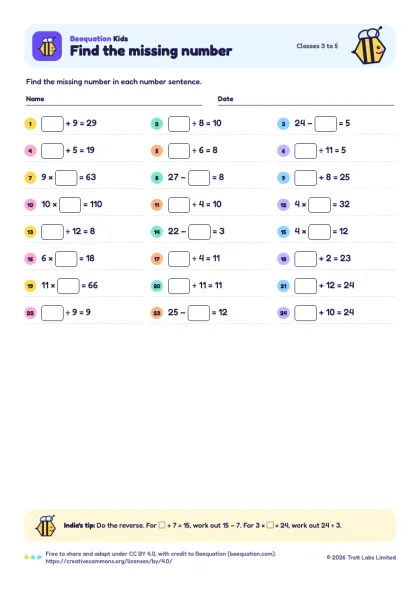 Find the missing numberClass 3, Class 4, Class 5 · Find the number in the boxDownload PDF
Braille (BRF) (1 KB) · Braille text (3 KB)
Questions parents and teachers ask
No. A box or a blank lets children reason about an unknown number using familiar calculations. Letters for unknowns usually begin in Class 6.
Ratio and proportion usually begin in Class 6. Informal equal-group and scaling problems, like the rice example above, are useful practice now.
Ask them to explain it and check all the terms given. A short sequence may allow several rules. A consistent explanation deserves discussion, even when it differs from the intended answer.
Practise with Indie
Beequation Kids turns number facts into honeycomb puzzles, with Indie giving a hint when a child is stuck. No ads and no data collected.