 Beequation

Learn › Maths topics for Classes 1 to 5 › Telling the time
Maths topics · Classes 1 to 5
Telling the time
School assembly, the lunch break and a bus departure give time a practical meaning. Children learn to read a clock more confidently when they connect its hands with events they know. Begin with the order of a day, then move to clock readings and the length of time between events.
Reading a time and calculating a duration are different tasks. A child may recognise 10:30 but still need help finding how long remains until 11:00. Work on one idea at a time and use a movable clock or a timeline to make the thinking visible.
Time across Classes 1 to 5
- Class 1: morning, afternoon, evening and night; days of the week; the order of familiar activities.
- Class 2: o'clock and half past in many books; months of the year and reading a calendar.
- Class 3: quarter past, half past and quarter to (the NCERT book writes “8:15 or quarter past 8”); five-minute steps and am and pm in many books.
- Class 4: am and pm, the 24-hour clock (in the NCERT book), durations and calendar problems.
- Class 5: changing between 12-hour and 24-hour times, timetables and durations.
The national NIPUN Bharat target for the end of Class 3 is reading the time on a clock in hours and half-hours. Schools organise these ideas differently, so use this list to choose an activity, not to check that your child has covered a clock skill by a particular month.
Understand the two hands
On an analogue clock, the shorter hour hand shows the hour. The longer minute hand shows how many minutes have passed since the hour began. One hour contains 60 minutes.
The minute hand makes a complete turn in an hour. As it moves, the hour hand also moves gradually towards the next hour. At half past three, the hour hand is halfway between 3 and 4; it is not fixed exactly on 3.
Use a teaching clock whose hands move together if one is available. With separate paper hands, remember to move the hour hand as well as the minute hand. Otherwise a model can accidentally teach an impossible clock reading.
O'clock and half past
When the minute hand points to 12 and the hour hand points to 8, the time is eight o'clock, written 8:00. The minute hand has reached the start of a new hour, so the minutes are 00.
When the minute hand points to 6, 30 minutes have passed. With the hour hand halfway between 8 and 9, the time is half past eight, written 8:30.
Ask your child to show both readings and describe what changes. “Half past” means half of the hour has passed: 30 out of 60 minutes. It does not mean half of the hour number.
Teach your child to look at the short hand first to find the hour, then at the long hand for the minutes. When the short hand lies between two numbers, ask, “Which hour has already started?”
Quarter past and quarter to
A quarter of an hour is 15 minutes. When the minute hand points to 3, 15 minutes have passed since the hour began. With the hour hand a little beyond 7, this is quarter past seven, written 7:15.
When the minute hand points to 9, 45 minutes have passed and 15 minutes remain before the next hour. With the hour hand approaching 8, the time is quarter to eight, written 7:45.
Compare the wording carefully:
- 7:15 is quarter past seven.
- 7:45 is quarter to eight.
“Past” names the hour already started; “to” names the hour coming next. Use a full clock turn divided into four equal parts to connect quarters with the 15-minute intervals.
Many children with Hindi at home will also hear सवा तीन (quarter past 3, 3:15), साढ़े तीन (half past 3, 3:30) and पौने चार (quarter to 4, 3:45), plus two special words: डेढ़ बजे for 1:30 and ढाई बजे for 2:30. Your family may use similar words in another language. Connecting them to the clock face can help.
Read five-minute intervals
There are five minutes between neighbouring clock numerals. Count in fives from 12: 5 at 1, 10 at 2, 15 at 3, and so on, reaching 60 on the return to 12.
If the minute hand points to 4, 20 minutes have passed. If the hour hand is between 9 and 10, the time is 9:20, or twenty past nine.
If the minute hand points to 10, 50 minutes have passed. With the hour hand approaching 10, the time is 9:50, or ten to ten. First count the minutes past, then find how many remain: 60 50 = 10.
The numeral 4 on a clock means four hours for the hour hand but twenty minutes for the minute hand. This is why children need to identify the hand before interpreting the numeral.
Digital times, morning and afternoon
A digital display such as 09:45 shows the hour before the colon and minutes after it. The leading zero doesn't change the hour: 09:45 is the same time as 9:45. Children also learn to read 9:45 as “nine forty-five”, and 3:15 as “three fifteen”.
In 12-hour notation, 9:45 am is in the morning and 9:45 pm is at night. Twelve noon is 12 pm; twelve midnight is 12 am. Writing “noon” or “midnight” can make a timetable clearer.
Railway tickets and timetables use the 24-hour clock, and the NCERT Class 4 and 5 books teach it. In 24-hour times, afternoon and evening hours continue beyond 12. For example, 14:30 is 2:30 pm because 14 12 = 2. A timetable reading 13:15 means 1:15 pm, not 13 minutes past an hour.
Don't add “pm” to 14:30: the 24-hour time already shows it is in the afternoon. Looking up a train on a ticket or a station board is a good real-life reason to practise.
Calculate elapsed time with a timeline
A maths period starts at 10:40 and finishes at 11:15. Count in two parts:
10:40 to 11:00 is 20 minutes.
11:00 to 11:15 is 15 minutes.
20 + 15 = 35 minutes.
A train journey starts at 09:45 and ends at 13:15 on the same day. Count 15 minutes to 10:00, three hours to 13:00 and another 15 minutes to 13:15. The journey lasts three hours and 30 minutes.
Check by adding the duration to the start: 09:45 plus three hours is 12:45, and another 30 minutes reaches 13:15. This avoids treating clock readings as decimal numbers.
When a journey crosses midnight, state the dates or explain that the arrival is on the next day. Without that information, a start and finish time may not determine a unique duration.
Use a calendar
Ask your child to locate today's date, find the same weekday in the next week and identify dates between two events. A week has seven days, but calendar months do not all have the same number of days.
For a practice question, suppose an event is on the 18th and today is the 14th of the same month. Four days remain: 14th to 15th, 15th to 16th, 16th to 17th and 17th to 18th. Counting both dates as whole days would give a different result, so explain whether the question asks for elapsed days or a list of dates.
Common mistakes and practical activities
- Swapping the hands: use clearly different lengths and ask which hand gives hours before reading.
- Leaving the hour hand still: show its gradual movement between consecutive hours.
- Reading 7:45 as quarter to seven: ask which hour comes next.
- Using 100 minutes in an hour: return to 60 minutes and draw jumps on a timeline.
Make a pretend school-day timetable with assembly, a maths period and the tiffin break. Ask children to show each start time, then find one duration. At home, set a paper clock to a planned activity and discuss how long remains. For a classroom starter, one child makes a clock reading and a partner writes it in words and digits.
Indie's challengeIndie starts sorting seeds at 10:40 and finishes at 11:15. How long does she spend sorting? Show the answer
From 10:40 to 11:00 is 20 minutes, and from 11:00 to 11:15 is 15 minutes. Indie spends 35 minutes sorting. Check: 10:40 plus 35 minutes is 11:15.
Free time worksheets
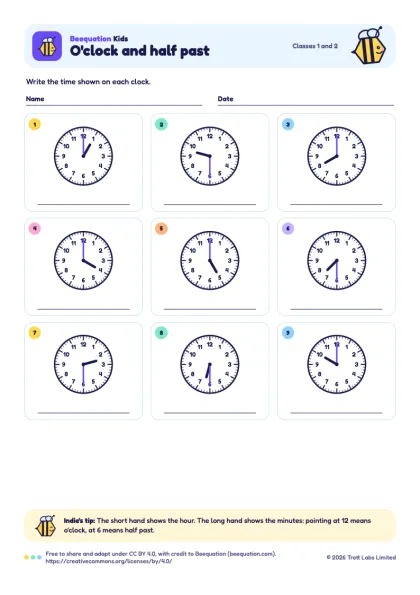 O'clock and half pastClass 1, Class 2 · Read the clocksDownload PDF
Braille (BRF) (1 KB) · Braille text (3 KB) · Tactile pictures (PDF) (95 KB)
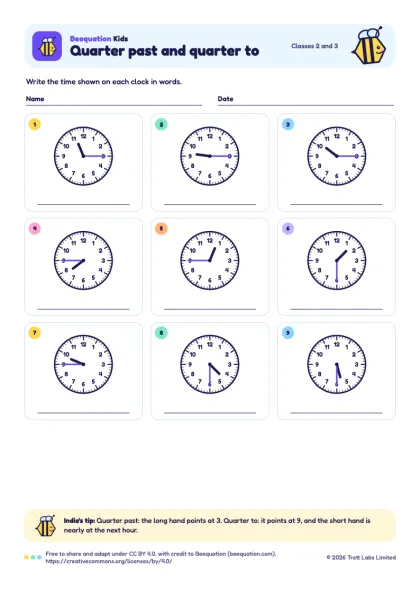 Quarter past and quarter toClass 2, Class 3 · Read the clocksDownload PDF
Braille (BRF) (2 KB) · Braille text (4 KB) · Tactile pictures (PDF) (95 KB)
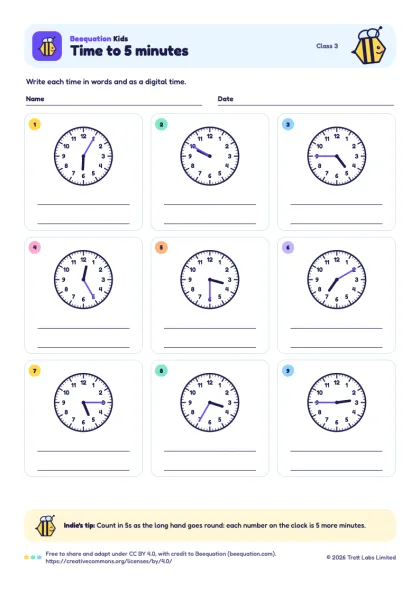 Time to 5 minutesClass 3 · Read the clocksDownload PDF
Braille (BRF) (2 KB) · Braille text (4 KB) · Tactile pictures (PDF) (94 KB)
Questions parents and teachers ask
Each numeral has different meanings for the two hands, and both hands move. Practise identifying the hands and connect a few readings with familiar events before adding more intervals.
Use both and connect them. For example, 7:45 is quarter to eight. Neither form replaces understanding where the hands are.
Clock units use 60 minutes in an hour, not 100. A timeline is a helpful starting method, especially when a duration crosses an hour.
Practise with Indie
Beequation Kids turns number facts into honeycomb puzzles, with Indie giving a hint when a child is stuck. No ads and no data collected.