 Beequation

Learn › Practical maths ideas for Classes 1 to 5 › A little puzzle pack for your classroom
Print, discuss, explain
A little puzzle pack for your classroom
A number hive gives children a small honeycomb of numbers and one task: find a number that can be made by adding or multiplying two of the others. There is something to notice, something to check and something to explain. You don't need a device for every child.
This free pack contains 24 hives: 12 addition hives with totals up to 20, and 12 multiplication hives. There are two question sheets and an answer key. Use one hive on the board, give a pair a sheet, or send a few puzzles home with instructions for the adult.
Download the pack
Download large print Download easy read
The large-print version uses text of at least 18 points. The easy-read version uses a cream background, dark text and more space. Choose the format that works for the child; an accessible format is not a different maths level.
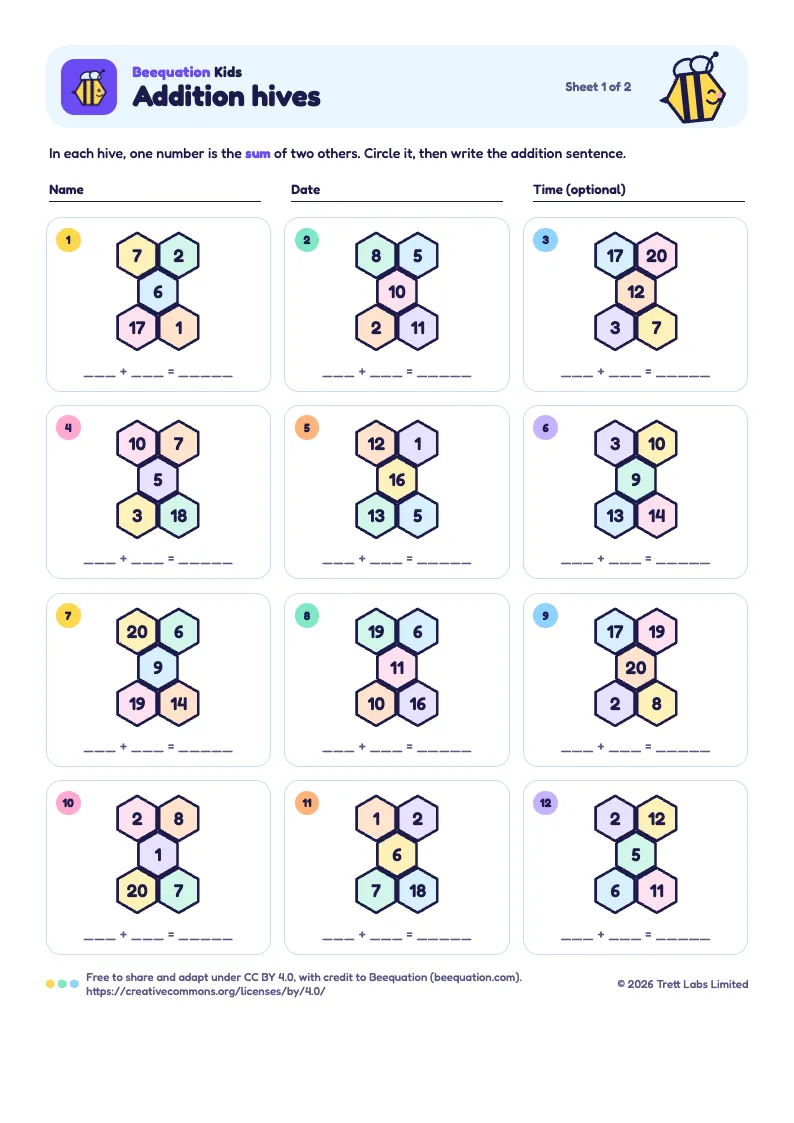
Show one hive before handing out a sheet
Write these numbers in a honeycomb: 7, 2, 6, 17, 1. Ask, “Can you find a number that is the sum of two other numbers here?” Children can choose 6 and 1, because 6 + 1 = 7. Circle 7 and write the complete number sentence.
Check it another way: start at 6 and count on one to reach 7. Or subtract 1 from 7 to get 6. The 17 is there to make children look carefully: being the biggest number doesn't make it the answer.
For a multiplication hive, the same idea becomes “Find a number that is the product of two others.” If a hive contains 4, 7 and 28, 4 7 = 28 is a connection. Four groups of seven make 28; seven groups of four also make 28. Children should use two separate cells, not use the same cell twice.
Keep the first hive on the board while children practise. Point to the two starting numbers and then the answer. That small gesture makes the rule much clearer than repeating “solve the puzzle”.
Which children is it for?
For Classes 1–2, begin with addition hives using totals the children already know. Counters, fingers and drawings are welcome. A child who is working on number bonds to 20 need not solve a whole sheet independently.
For Classes 2–3, introduce multiplication hives when equal groups and the relevant tables have been taught. The multiplication sheet practises tables from 2 to 6. Follow your school's sequence rather than using the pack to introduce all these tables at once.
For Classes 4–5, familiar calculations can still prompt useful reasoning. Ask children to explain an efficient search, write the related division facts, or make a new hive for another pair. Difficulty can come from the explanation, not only from bigger numbers.
Five ways to use it
- A board starter: display one hive, allow thinking time, then collect two explanations. Five minutes is a possible classroom slot, not a time limit for every child.
- Pair talk: one child proposes a connection; the other checks it. Swap roles for the next hive.
- Concrete practice: let children build the two groups with counters, then bring them together and match the total.
- An early-finisher task: ask children to make a hive, solve it themselves and supply an answer for their partner.
- Home practice: send one or two hives with the rule. Ask the adult to listen to the child's method rather than race through the answers.
The printed pack is in English. In a Hindi-medium or another language-medium classroom, explain the rule orally in the class's usual language. The mathematical connection stays the same; children should not be held back by the wording of a new activity.
Let children make the next hive
Start with a checked number sentence, such as 8 + 5 = 13. Put 8, 5 and 13 in three cells, then add two other numbers. Check all pairs before using the hive: another valid connection may appear. If it does, accept and discuss it rather than insisting on your original answer.
For multiplication, start with 3 6 = 18. Children can draw three rows of six to verify the total. Choosing the extra numbers starts a good discussion about what does not fit.
Printing, sharing and credit
The puzzle pack is shared under CC BY 4.0. You may print, share and adapt it with credit to Beequation (beequation.com), and indicate changes if you make them. This licence covers the pack, not Beequation's game, brand or Indie artwork generally.
For more printable practice, visit the worksheet library. For classroom routines, see maths starters and classroom games.
Indie's challengeA hive contains 8, 5, 13, 2 and 19. Which number can you circle for an addition connection? Show the answer
Circle 13: 8 + 5 = 13. Check by counting on five from eight, or by subtracting 8 from 13 to get 5. You must use two other cells to make your answer.
Practise with Indie
Beequation Kids turns number facts into honeycomb puzzles, with Indie giving a hint when a child is stuck. No ads and no data collected.