 Beequation

Learn › Maths topics for Classes 1 to 5 › Measurement
Maths topics · Classes 1 to 5
Measurement
A pencil is longer than an eraser, a full school bag feels heavier than an empty one, and a jug holds more water than a cup. These comparisons are the starting point for measurement. Children need plenty of opportunities to handle, compare and estimate before a written conversion makes sense.
At home or in class, ask three questions: “What are we measuring?”, “Which unit would help?” and “Does the answer seem reasonable?” A correct number without a unit does not tell us whether a ribbon is 20 centimetres or 20 metres long.
How measurement develops
Use this as a broad guide. Follow your child's textbook for the units, conversions and methods expected in a particular Class.
- Class 1: compare longer and shorter, heavier and lighter, and containers that hold more or less. Measure with handspans, footsteps or pencils.
- Class 2: centimetres and metres with a scale, and a first look at kilograms and litres.
- Class 3: cm, m and km; g and kg; mL and L; simple conversions such as 1 m = 100 cm.
- Class 4: conversions between units, perimeter by adding the sides, and area by counting squares.
- Class 5: perimeter and area of rectangles and squares, and volume by counting cubes.
Start with equal units
Lay identical paper clips along a book's edge without gaps or overlaps. If eight clips fit, its length is eight of those paper clips. Another child may get a different answer with larger clips: the unit has changed, not the book.
Handspans (a balisht in Hindi) and footsteps make this difference visible. Two children can measure the same classroom using their own steps and compare their answers. This gives a reason for using standard units that stay the same for everyone.
Before introducing a scale, ask your child to measure with identical blocks. Watch whether the blocks touch and whether the first block starts at the object's edge. These habits carry over to accurate work with a scale.
Length: begin at zero
A scale (ruler) measures the distance between marks. Line up the beginning of an object with the zero mark, not necessarily the end of the plastic scale. Read the mark at the other end and include the unit.
When the object cannot start at zero, find the difference between the readings. A ribbon beginning at 3 cm and ending at 11 cm is 11 3 = 8 cm long. It is not 11 cm long.
- 10 millimetres (mm) = 1 centimetre (cm).
- 100 centimetres = 1 metre (m).
- 1,000 metres = 1 kilometre (km).
Choose a useful unit: centimetres for a pencil, metres for a room and kilometres for a journey. Estimates need not be exact, but they should fit the object. A classroom door is unlikely to be only 2 cm high.
Weight: compare, then calculate
“Weight” is the familiar primary-school word for these activities. A balance lets children compare objects directly; a weighing scale gives a reading in grams or kilograms. A larger-looking object is not always heavier.
1,000 grams (g) = 1 kilogram (kg). A packet weighing 1,250 g contains 1,000 g and another 250 g, so its weight is 1 kg 250 g. Writing 1 kg 25 g would lose 225 g.
At the sabzi market, a quarter kilogram is often called a paav. Connect that familiar expression to 250 g; do not assume every child uses it at home. Four 250 g portions together make 1 kg.
Let children estimate which of two safe objects is heavier, then check. Ask what surprised them rather than awarding points for the closest guess.
Capacity: how much a container holds
Capacity describes how much a container can hold. The amount of water currently inside it may be smaller than its capacity. An empty 1 L bottle still has a capacity of 1 L.
1,000 millilitres (mL) = 1 litre (L). Two 500 mL milk packets make 1 L altogether. Four 250 mL cups also hold 1 L, provided the cups really hold 250 mL each.
A tall, narrow glass can look as though it holds more than a short, wide one. Pouring between containers helps children check rather than rely on height alone. Use a tray, small quantities and a measuring jug; read its scale carefully.
Perimeter and area answer different questions
Perimeter is the distance around a shape. Area is the amount of surface it covers. Walking round a playground fence suggests perimeter; covering a floor with equal square tiles suggests area.
Consider a rectangle 7 cm long and 4 cm wide:
- Perimeter: 7 + 4 + 7 + 4 = 22 cm.
- Area: 7 4 = 28 square centimetres (28 cm²).
First count square units in rows, then connect the count to multiplication. The area formula is useful because a rectangle has equal-length rows, not because every shape can be measured by multiplying two numbers.
In Class 5, many books explore volume by building shapes from cubes. Keep cubic units distinct from square units. Some books also read temperatures in degrees Celsius (°C): read the scale rather than applying length-conversion rules.
Common mistakes to discuss
- Missing units: “The length is 8” needs “8 cm” or another appropriate unit.
- Counting ruler marks: count the spaces between marks, not both end marks.
- Mixing units: change quantities to a common unit before adding, unless working explicitly with mixed units.
- Confusing perimeter and area: trace the boundary, then shade the surface, and name each measurement.
Five-minute games for home
- Ribbon estimates: predict which ribbon is closest to 30 cm, then measure each one.
- Kitchen weights: read the labels on packets of atta, dal or rice and arrange the packets by weight.
- Fill the bottle: predict how many 250 mL portions fill a 1 L bottle, then check.
- Tile a rectangle: use squared paper to draw two rectangles with equal area and compare their perimeters.
- Unit detective: discuss whether mm, cm, m or km would suit different objects and journeys.
Indie's challengeA rectangular garden is 6 m long and 3 m wide. What are its perimeter and area? Show the answer
Its perimeter is 6 + 3 + 6 + 3 = 18 m. Its area is 6 3 = 18 m². The numbers happen to match, but the measurements and units are different.
Free measurement worksheets
Use practical measuring first. This sheet is useful when your child is ready to connect rectangular boundaries and square units with calculations.
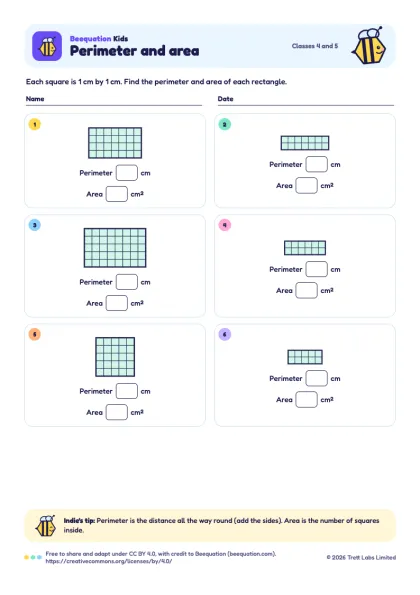 Perimeter and areaClass 4, Class 5 · Rectangles on a centimetre gridDownload PDF
Braille (BRF) (2 KB) · Braille text (4 KB) · Tactile pictures (PDF) (59 KB)
Questions parents and teachers ask
Introduce the conversions their textbook requires, using real quantities. Repeatedly measuring 100 cm as 1 m is more meaningful than learning an unrelated list of unit names.
Ask them to say the whole answer aloud and write the unit beside each measurement. Comparing “8 cm” with “8 m” shows why the unit is part of the answer.
Yes, for comparing or counting equal cupfuls. To claim a numerical amount in mL, check the cup's capacity with a measuring jug; ordinary cups do not all hold the same amount.
Practise with Indie
Beequation Kids turns number facts into honeycomb puzzles, with Indie giving a hint when a child is stuck. No ads and no data collected.