 Beequation

Learn › Mental maths is choosing a useful route
Think about the numbers
Mental maths is choosing a useful route
Mental maths does not mean doing a written calculation invisibly in your head. It means noticing something useful about the numbers. A number close to ten, a double you already know or a smaller related table fact can give you a shorter route.
Children in Classes 1 to 5 need different starting points. Begin with counters and small numbers, then use pictures, a number line or rough work as needed. “Mental” should not become a reason to refuse support. Ask a child to explain a route before asking for quicker recall.
Ask, “What do you already know that could help?” Don't turn it into a race. Give your child thinking time and accept a different correct method.
1. Bridge through ten
For 8 + 5, eight needs two to reach ten. Split five into two and three: 8 + 2 = 10, then 10 + 3 = 13. Show the split with counters or two jumps on a number line.
Try 9 + 4 in the same way: 9 + 1 + 3 = 13. In Class 1 or 2, this connects number bonds with addition. Later, the same idea can help cross a multiple of ten. For 28 + 7, add two to reach 30 and then five to reach 35.
Watch for a child who adds the two but then adds all five again. Keep the original five counters separate and move only two of them first.
2. Partition into tens and ones
To calculate 47 + 38, separate the place values. The tens give 40 + 30 = 70. The ones give 7 + 8 = 15. Combine them: 70 + 15 = 85.
Another route is 47 + 30 = 77, followed by 77 + 8 = 85. Both routes are valid. Ask which is more comfortable and why. For subtraction, start with a case that doesn't need borrowing, such as 68 24: 68 20 = 48, then 48 4 = 44. Introduce trickier cases only when the child understands the change in place value.
Bundles of ten sticks and loose sticks make the tens-and-ones structure visible. An abacus can also support place value; it is a tool, not a separate requirement for learning maths.
3. Use a near double
If a child knows 6 + 6 = 12, then 6 + 7 is one more: 13. If the child knows 7 + 7 = 14, then 6 + 7 is one less: again 13.
Build two equal rows of counters and add one counter to one row. Ask why the total increases by one, not by two. Later, use 25 + 26 = 50 + 1 = 51. The numbers need to be close enough for the double to be helpful; there is no need to force this method onto every addition.
4. Round, then adjust
For 49 + 26, use the nearby 50: 50 + 26 = 76. You added one too many, so subtract one. The answer is 75.
A price example works similarly. ₹99 + ₹45 is ₹100 + ₹45 ₹1 = ₹144. Ask, “Did we make the starting number bigger or smaller?” That question helps a child decide the direction of the adjustment.
For 63 19, subtract 20 to get 43, then give back one: 44. Subtracting 20 removed one too many. Use a drawing or number line if the correction is confusing.
5. Count up to find a difference
To find 100 63, count up from 63: seven to reach 70, then 30 to reach 100. The difference is 7 + 30 = 37.
This is useful for change as well. If a bill is ₹63 and you pay ₹100, the change is ₹37. Ask the child to show the two jumps and check that ₹63 + ₹37 = ₹100. It is a difference method, not a rule that subtraction always means counting up.
Compare it with counting back for 100 3. Taking away three is probably the more convenient route there. Choosing between methods is part of the learning.
6. Double one factor and halve the other
For 16 5, halve 16 to get eight and double five to get ten. Then 8 10 = 80. The product stays the same because one factor has been halved while the other has been doubled.
Show 16 groups of five counters paired into eight groups of ten. For a child who is comfortable with larger numbers, 16 25 becomes 8 50, then 4 100 = 400. Keep this as an extension when it fits the child's current work.
You can also use repeated doubling for a table fact: 6 2 = 12, 6 4 = 24 and 6 8 = 48. Explain which factor is changing at each step.
7. Use a fact from the table of 10
For 9 7, begin with ten sevens: 10 7 = 70. Remove one seven to get 63. For 11 7, add one seven to 70 to get 77.
An array with ten rows makes both relationships visible. Cover one row for nine rows; add a row for eleven. Tables beyond ten may be taught earlier in some schools, but they are not a universal Class 2 or Class 3 requirement. Use them when they match your child's school book, or as an optional exploration.
The same structure explains 99 6 = 100 6 6 = 594. This larger example is for children ready for it, not a starting exercise.
8. Check with odd and even numbers
Odd and even patterns can check a result, though they do not produce the full answer. Two odd numbers add to an even number: 7 + 9 = 16. An odd and an even number add to an odd number: 7 + 8 = 15.
If a child writes 7 + 8 = 14, the pattern tells you something is wrong. If the child writes 17, the odd result passes that check but is still incorrect. Follow it with another check, such as a near double. A useful check should be understood along with its limits.
A routine that fits a school day
Choose three questions using the same idea. Model the first, solve the second together and let the child explain the third. On another day, offer two possible strategies and ask which the child would choose. Write down the method if remembering all the steps is getting in the way.
Vedic maths or abacus classes are optional. They do not replace understanding the operations, and no paid course is needed to use these strategies. Keep school methods and a child's successful reasoning connected rather than setting them against each other.
Indie's challengeWork out 49 + 26 in two ways. How can you check the answer? Show the answer
Round and adjust: 50 + 26 1 = 75. Partition: 40 + 20 + 9 + 6 = 60 + 15 = 75. Check with subtraction: 75 26 = 49.
Explore place value or times tables practice if a related fact needs attention first.
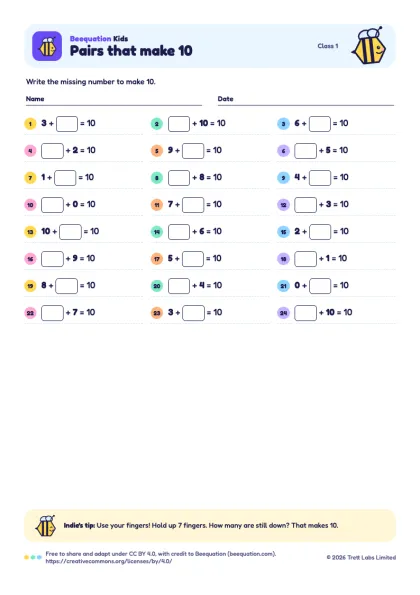 Pairs that make 10Class 1 · Number pairs that add up to 10Download PDF
Braille (BRF) (1 KB) · Braille text (3 KB)
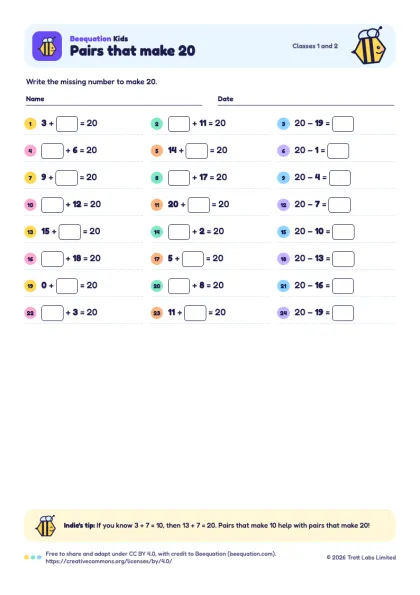 Pairs that make 20Class 1, Class 2 · Number pairs that add up to 20Download PDF
Braille (BRF) (1 KB) · Braille text (3 KB)
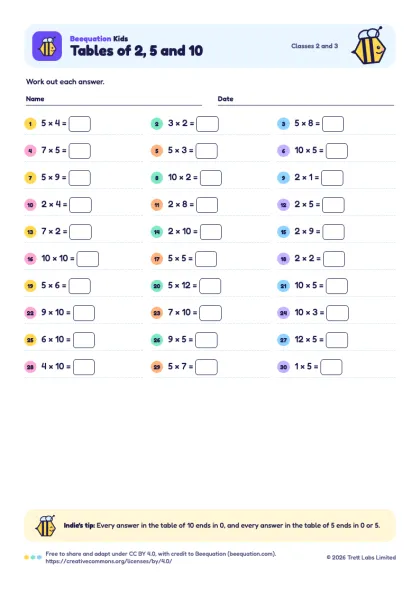 Tables of 2, 5 and 10Class 2, Class 3 · Mixed questions from the tablesDownload PDF
Braille (BRF) (2 KB) · Braille text (4 KB)
No. A sketch or a few written steps can help a child understand and explain a strategy. Reduce support gradually rather than taking it away before the idea is secure.
Practise with Indie
Beequation Kids turns number facts into honeycomb puzzles, with Indie giving a hint when a child is stuck. No ads and no data collected.