 Beequation

Learn › Times tables: understand, practise and remember
Times tables: understand, practise and remember
Tables (पहाड़े in Hindi) are useful, but reciting a table and understanding multiplication are not quite the same thing. A child may chant “six eights are forty-eight” yet be unsure how to use it in a word problem. Give equal groups and pictures a place alongside oral practice.
In Class 2, children begin working with small equal groups and familiar tables. The national NIPUN Bharat mission expects children to build the tables of 2, 3 and 4 in Class 2, and the tables of 2 to 10 by the end of Class 3. Follow the order used by your child's school. Some schools also practise tables from 11 to 20; treat these as additional practice, not a single national requirement for every primary child.
Start with equal groups
Put three counters in each of four bowls. Ask, “How many groups? How many in each group? How many altogether?” There are four groups of three, making 12. Write 4 3 = 12 and connect it to 3 + 3 + 3 + 3.
Now arrange the counters in four rows of three. This is an array. Turn the arrangement so it has three rows of four: it still contains 12 counters, so 3 4 = 12 too. The product is unchanged, although three children receiving four pencils each is a different situation from four children receiving three each.
Ask for one drawing or explanation before a page of answers. If equal groups are not clear yet, more chanting alone will not resolve the difficulty.
Build new facts from known ones
The tables of 2, 4 and 8: double
For 2 7, double 7 to get 14. Double 14 to find 4 7 = 28. Double 28 to find 8 7 = 56. Each step doubles the number of equal groups.
Check 4 7 another way: two groups of 7 make 14, and another two make 14, so four groups make 28. Encourage the child to explain the doubling rather than memorise a disconnected instruction.
The table of 5: use the table of 10
Ten groups of 8 make 80. Five groups are half as many, so 5 8 = 40. Draw ten groups and divide them into two sets of five if “half as many groups” needs explanation.
The table of 9: one group less
For 9 7, begin with 10 7 = 70 and take away one group of 7. That gives 70 7 = 63. Check with 7 9 = 63, or nine jumps of 7.
The table of 6: add another group
If 5 8 = 40 is secure, then 6 8 is 40 + 8 = 48. A drawing of five groups followed by one more makes the relationship visible. Similarly, 6 7 = 35 + 7 = 42.
Use the whole fact family
One multiplication fact gives four related equations:
- 6 8 = 48
- 8 6 = 48
- 48 6 = 8
- 48 8 = 6
Show both meanings of division. Sharing 48 counters equally among six children gives eight each. Making groups of eight from 48 counters gives six groups. Both use the same fact family, but the questions are different.
A missing-number question, such as 7 □ = 35, invites the child to use division or a known table fact. The missing number is 5 because five groups of 7 make 35.
A short practice routine
- Build or draw one fact.
- Say the equation and explain a helpful relationship.
- Answer a few shuffled questions, including a division question.
- Return to a difficult fact with a picture or known fact.
- Revisit it in another short session.
Clapping, chanting and oral questions can make practice lively, provided children can also work without the rhythm. Mix the order once the sequence is familiar. Otherwise a child may need to start at the beginning of the table every time.
Use small cards with questions on one side and answers on the other. Sort them into “I can explain this” and “I need another look”. Keep the piles temporary: today's uncertain fact may be tomorrow's familiar one.
Use a multiplication grid thoughtfully
A 10 10 grid helps children notice repeated products and the symmetry across the diagonal. Ask them to locate 3 4 and 4 3, then explain why both are 12. Cover a few entries and reconstruct them from neighbours.
A larger grid can be an extension if it matches the school's work. It need not replace secure understanding of smaller facts. Children should be able to use a grid as a learning tool without being labelled weak for needing it.
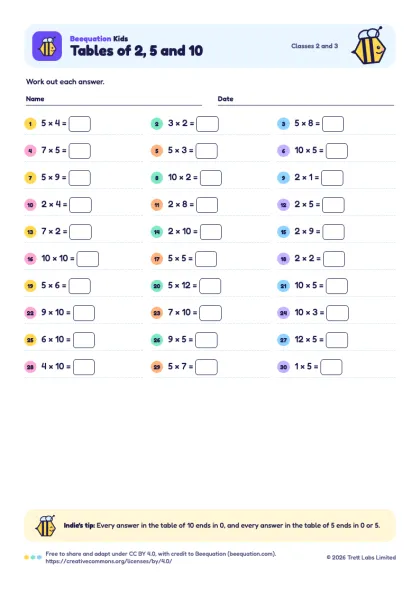 Tables of 2, 5 and 10Class 2, Class 3 · Mixed questions from the tablesDownload PDF
Braille (BRF) (2 KB) · Braille text (4 KB)
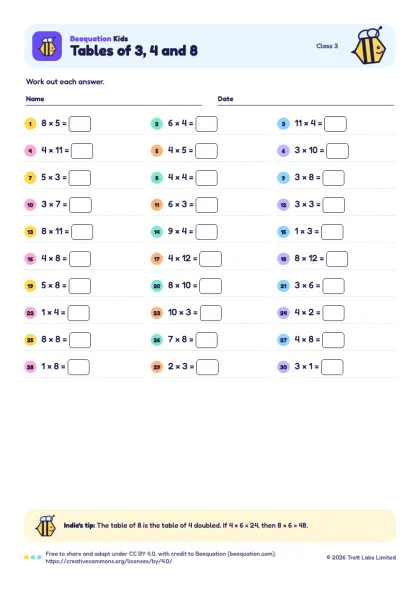 Tables of 3, 4 and 8Class 3 · Mixed questions from the tablesDownload PDF
Braille (BRF) (2 KB) · Braille text (4 KB)
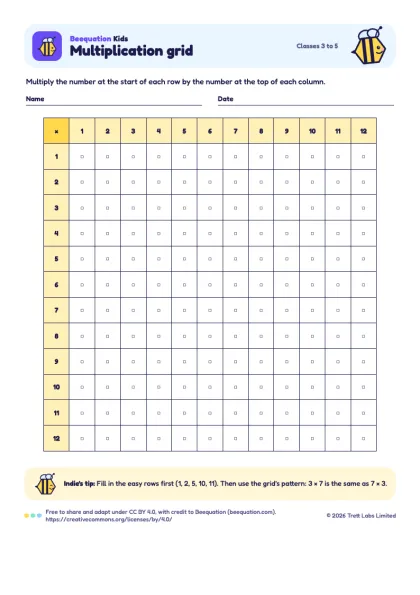 Multiplication gridClass 3, Class 4, Class 5 · Fill in the 12 12 gridDownload PDF
Braille (BRF) (5 KB) · Braille text (14 KB) · Tactile pictures (PDF) (114 KB)
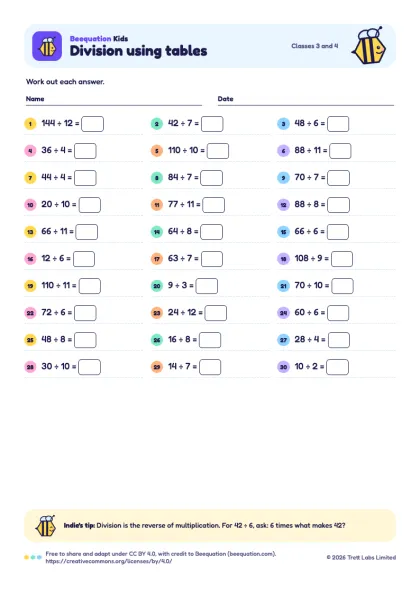 Division using tablesClass 3, Class 4 · Use the tables to divideDownload PDF
Braille (BRF) (2 KB) · Braille text (4 KB)
When an answer doesn't come quickly
Distinguish a recall difficulty from an understanding difficulty. A child who draws six groups of eight correctly understands more than a hesitant oral answer might suggest. Help them choose a shorter route from a known fact, then practise retrieval gently.
Timing is optional. Establish accuracy and a usable strategy first. Avoid public speed rankings or asking siblings to compete. If your child becomes anxious, remove the timer and choose fewer questions.
Connect practice to multiplication and division or try a classroom game. For addition relationships that support table learning, see number bonds to 20.
Indie's challengeYou remember 5 8 = 40 but forget 6 8. Find the answer and check it. Show the answer
Add one more group of eight: 40 + 8 = 48. Check by doubling 3 8 = 24, giving 24 + 24 = 48, or use 48 6 = 8.
Practise with Indie
Beequation Kids turns number facts into honeycomb puzzles, with Indie giving a hint when a child is stuck. No ads and no data collected.