 Beequation

Learn › Number bonds to 20
Small facts, useful connections
Number bonds to 20
Put 20 beads on the table. Move eight to one side and leave 12 on the other. The beads have not changed in number: you have shown two parts of the same whole. That is the idea behind a number bond.
Number bonds are pairs of numbers that make a particular total. Your child's book may call them “pairs that make 10”, “making 10” or “addition facts”; the idea is the same. For 20, 8 + 12 is one bond and 15 + 5 is another. Children meet smaller totals first. In Class 1, start with the numbers in the current lesson, often within 9 or 10, before extending to 20. In Class 2, these connections support addition and subtraction. The pace will depend on the school and the child.
Use beads, bottle caps or drawn circles before asking for an answer from memory. Check that your child can see the two parts, not only say the pair.
Begin with a whole the child can see
Choose ten counters. Count them once, then split them into two groups. Ask, “How many here? How many there? How many altogether?” Write 6 + 4 = 10 beside the groups. Move one counter from the group of six to the group of four. Now 5 + 5 = 10. Ask what changed and what stayed the same.
A part–whole picture can help. Draw one circle for the total and two smaller circles for the parts. Put 10 in the whole, and 6 and 4 in the parts. You can call it a number bond picture without requiring a particular diagram: the relationship matters more than the shape of the drawing.
Keep zero in the discussion. If all ten counters are in one group and the other group is empty, 10 + 0 = 10. An empty group is still a possible part.
The pairs for 10 and 20
Here are the pairs without repeating a pair in the opposite order.
| Bonds to 10 | Bonds to 20 |
|---|---|
| 0 + 10 | 0 + 20 |
| 1 + 9 | 1 + 19 |
| 2 + 8 | 2 + 18 |
| 3 + 7 | 3 + 17 |
| 4 + 6 | 4 + 16 |
| 5 + 5 | 5 + 15 |
| — | 6 + 14 |
| — | 7 + 13 |
| — | 8 + 12 |
| — | 9 + 11 |
| — | 10 + 10 |
There are six such pairs for 10 and 11 for 20. Swapping the parts gives the same total: 13 + 7 = 20 and 7 + 13 = 20. Let the child demonstrate this by moving the two groups, rather than learning two unrelated facts.
Use ten to work out a bond to 20
Arrange 20 counters in two rows of ten. Cover or move 13: one whole row and three from the next row. Seven remain, so 13 + 7 = 20. The bond 3 + 7 = 10 is doing some of the work.
For 8 + □ = 20, first find the two needed to make ten. Another ten takes the total to 20. The missing part is 12: 8 + 2 + 10 = 20, so 8 + 12 = 20.
This is not a rule to chant before the child understands tens. If counting is still useful, keep the counters and point to each part. Gradually ask the child to predict the answer before uncovering it.
Connect addition with subtraction
Keep the same groups of 13 and seven. Together they make 20. If you remove the 13, seven remain. If you remove seven, 13 remain. Write the connected facts:
- 13 + 7 = 20
- 7 + 13 = 20
- 20 13 = 7
- 20 7 = 13
Ask the child to match each sentence to an action with the counters. This is more useful than presenting four lines as a copying exercise. It also helps with a blank in a different position, such as 20 □ = 7.
Make ten inside another sum
Number bonds are useful beyond their original total. To work out 8 + 5, split the five into two and three. Add two to eight to make ten, then add three: 8 + 5 = 8 + 2 + 3 = 13.
For 15 7, split the seven into five and two. Take away five to reach ten, then take away two more: 15 7 = 15 5 2 = 8. Use a number line if the child needs to see the two jumps. Don't insist on this method when counting back is the current school method; show the connection alongside it.
Three short activities
Hide a part
Count ten counters, hide four under a cup and leave six visible. Ask how many are hidden, then lift the cup to check. Move to 20 only when the smaller total is secure. The adult should keep the original total unchanged.
Match the bangles
Draw groups of bangles on small cards: one card with seven, another with three, and several other quantities. Find two cards that make ten. Use drawings or larger counters rather than small objects with children who may put them in their mouths.
Find a honeycomb relationship
Write 4, 8, 10, 6 and 5 in five cells. Look for two numbers whose sum is another number shown. Here 4 + 6 = 10. The spare numbers invite careful checking rather than a guess based on the largest number.
Indie's challengeThe whole is 20 and one part is 14. What is the other part? Show how you know. Show the answer
The other part is 6. You can count from 14 to 20, or use 4 + 6 = 10 and the extra ten in 14. Check both 14 + 6 = 20 and 20 14 = 6.
Keep practice small and varied
Choose four pairs, not a long timed list. Ask one orally, draw one, fill one blank and explain one subtraction. If a child gives 13 + 8 = 20, return to the counters: 13 + 8 makes 21. Let the child notice the extra counter and correct the pair.
When the child is ready, connect these ideas to addition and subtraction and mental maths strategies. For a smaller starting point, use the Class 1 page.
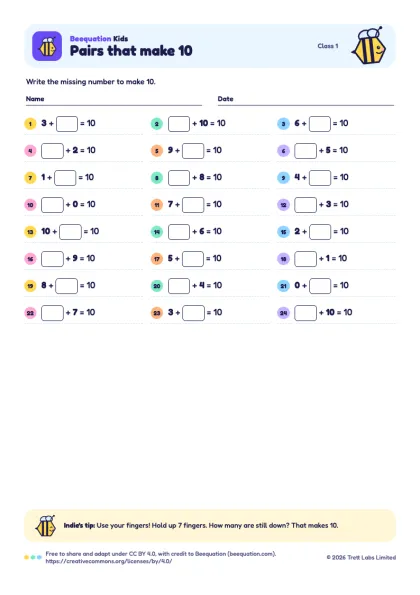 Pairs that make 10Class 1 · Number pairs that add up to 10Download PDF
Braille (BRF) (1 KB) · Braille text (3 KB)
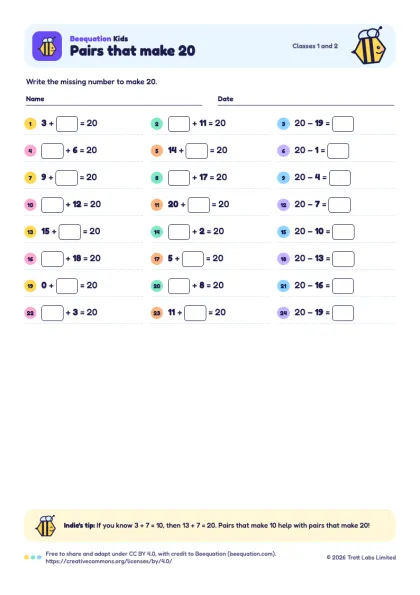 Pairs that make 20Class 1, Class 2 · Number pairs that add up to 20Download PDF
Braille (BRF) (1 KB) · Braille text (3 KB)
No. Start with a total the child understands and build from there. School expectations and teaching sequences vary. Confident use of a picture or counting strategy is a useful step towards recall.
Yes. Fingers can show small parts and totals. For 20, use counters in two rows of ten, bundles and sticks, or a number line so the whole remains visible.
Practise with Indie
Beequation Kids turns number facts into honeycomb puzzles, with Indie giving a hint when a child is stuck. No ads and no data collected.